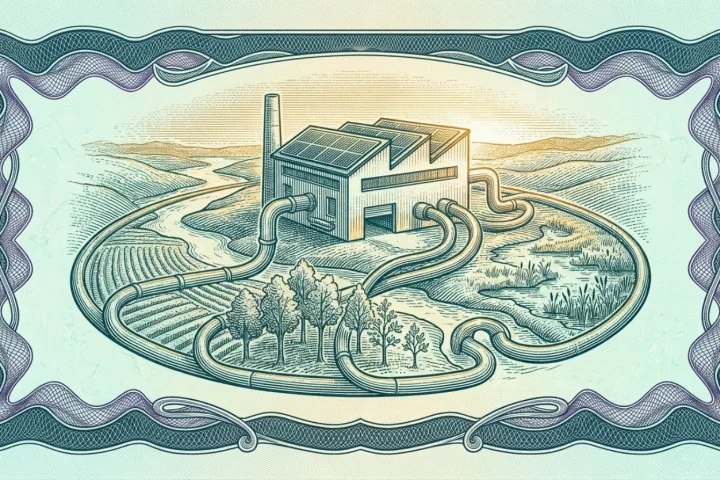
When rural economies are in trouble, community leaders often turn to the same old solutions - extract more from the natural environment or make big concessions to recruit large companies. Alana Probst has been developing a very differnt approach. When Alana Probst argues that it is possible to make a livelihood that
does not overtax nature, she cannot be accused of being an armchair
environmentalist who doesn't know what it is like making a living off
the land. Her father was the general manager of a large sawmill
operation that used clear-cut techniques on some of the best forests in
Oregon. A tall, blonde woman with an easy smile, Probst grew up in a
number of small towns, moving from one logging community to another as
the supplies of standing timber were exhausted. She knows what it is
like to see people lose their jobs and be forced to move out of town
after an area is logged out.
It is this background, as a member
of a fourth-generation logging family, as well as her training as an
economist that equips Probst to talk with loggers, farmers, and
fishermen about changing the way they harvest the bounty of nature in
the Pacific Northwest.
Probst is one of a number of economists
who are pioneering a new field of conservation-based development in
which the emphasis is on creating jobs that are ecologically
sustainable. The central thesis of conservation-based development is
that passing laws and regulations that protect nature, without
providing for the needs of local people, is a strategy doomed to
failure. To protect an ecosystem, the people who live in it must have
access to the information, tools, and capital necessary to build
enterprises that do not destroy the vitality of the ecosystem on which
they depend.
This conservation and job-generation
approach was tested by Probst in Willapa Bay, Washington, a watershed
about the size of Rhode Island that is host to one of the healthiest
estuaries remaining on the west coast.
Twenty-one
bird species, nine plants, two salamanders, a butterfly, and a snail on
the threatened or endangered species list make their homes in the
Willapa Bay rainforest. The Douglas fir and western hemlock also
provide a habitat for elk, black bear, mule deer, mountain lion,
bobcat, coyote, raccoon, beaver, river otter, northern flying squirrel,
and many small rodents and insect eaters.
Willapa's rich ecosystem also provides a living for many of its 20,000 residents, and as a result, much of
Willapa is essentially a farming community. One out of every six
oysters consumed in the US is cultivated in 10,000 acres of Willapa
tidelands. Some 25,000 to 200,000 chum, coho, and Chinook salmon are
caught in these waters every year, lthough, as the salmon catch
has declined, hatcheries are replacing the wild runs of these fish.
Around 14,000 acres of cranberry bogs form the agricultural base of the
community. And loggers harvest native trees from the surrounding
forests.
Not surprisingly, local harvests have put
tremendous stress on the ecosystem. By 1977, half of the shoreline
wetlands had been diked. Since then, road building and industrial
development have further diminished tidal marshland. An epidemic of
inedible ghost shrimp – likely caused by the overfishing of chum
salmon, which had previously kept the ghost shrimp populations in check
– has wiped out 20,000 to 30,000 acres of cultivated mud flats,
thereby reducing the oyster population as well. In addition, Willapa's
forests have taken a big hit from logging.
Seeing the ecosystem as a whole Having
identified the Willapa watershed as an ecosystem worth working to
preserve, officials at Ecotrust, a small conservation group located in
Portland, Oregon, assembled a team of conservation-based development
specialists to provide financial support, and business planning and
marketing assistance to ecologically sustainable enterprises within the
watershed. Alana Probst joined this team and then moved to Willapa Bay,
where she worked with a select group of local entrepreneurs.
“We
wanted to find ways for small businesses to become engines for
environmental restoration of ecosystems damaged by humans,” Probst says.
But
from the outset, any project such as this is fraught with pitfalls.
Many rural communities are sharply divided over conservation and
resource extraction issues. It is not unusual for local farmers,
loggers, fishers, and ranchers to be suspicious of big city
environmentalists who blow into town for a few days to lecture them on
how they are not treating Mother Nature with the respect that is her
due, and then proceed to tell them how they should run their
businesses.
Fortunately, Probst and others at
Ecotrust were savvy enough to recognize that this kind of approach
could not succeed. Instead, they moved to town quietly and began
searching out local entrepreneurs with whom they could work. In concert
with the Nature Conservancy, they organized a meeting in 1992 out of
which the Willapa Alliance was formed, a group of local residents whose
board of directors includes oyster growers, fishers, farmers, small
business operators, landowners, and members of the Shoalwater Bay
Native American tribe. Describing itself as “dedicated to developing
and implementing strategies for sustainable, conservation-based
economic development in the Willapa ecosystem,” the Alliance was formed
out of a sense that previous efforts to keep the Willapa Bay ecosystem
healthy had failed to see the ecosystem as a whole.
But
building a sustainable economy in Willapa means more than just talking
people into installing efficient septic systems so that sewage will not
contaminate the bay. It also involves creating jobs that add value to
sustainably harvested resources. During the first year she lived in
Willapa Bay, Probst watched 13 small businesses and noticed that none
could get a bank loan to expand operations. To meet this need for
capital, Probst went looking for money to invest in fledgling
eco-sensitive enterprises. Her search led to the South Shore Bank in
Chicago, a progressive bank that has invested over $500 million in low-
and moderate-income minority communities in Chicago using innovative
yet rigorous banking practices. By 1994, Ecotrust and South Shore's
holding company, Shorebank Corporation, began to work together with a
small number of local entrepreneurs. The idea was to focus on
enterprises that rely on a healthy, productive, and intact ecosystem
for successful production.
Probst and her
colleagues opened Shorebank Enterprise Pacific, a nonprofit business
development group and loan fund supported by Ecotrust and Shorebank
Corporation, which provides non-bank loans and business expertise to
local businesses seeking to improve environmental management. Shorebank
Enterprise, joined by its sister for-profit bank, ShoreBank Pacific,
now has a $5.2 million high-risk revolving loan fund designed to
improve environment and equity through economic opportunity.
One
of the local entrepreneurs Shorebank Enterprise supported is Karen
Snyder, owner of Anna Lena's, a manufacturer of specialty foods made
from cranberries. For decades, cranberries have been the most valuable
agricultural crop in Willapa Bay because the bogs along the coast
provide ideal conditions for them. Most of Willapa's cranberries,
however, are shipped off to large juice manufacturers such as Ocean
Spray instead of being processed locally.
Karen
Snyder decided to buck this trend. “It was sad when people couldn't buy
cranberries in an area where they are surrounded by them,” observes
Snyder. Snyder cooked up a recipe for cranberry relish passed down to
her by her great-grandmother, Anna Lena, bottled it, and sold it
locally. She now sells 40 specialty items made from cranberries,
including cranberry catsup, scone mix, and jelly.
As
the business grew, Snyder got help with marketing through Shorebank
Enterprise. She also redesigned her labels to emphasize the firm's
environmental values, the pristine environment in which the cranberries
are harvested, and the natural processing techniques used. In 1997,
Snyder expanded her operation by planting her own cranberry bog and
opening a local retail store.
Shorebank
Enterprise also made a loan to a local crab fisher, who took steps to
modify his fishing practices. For example, he agreed to forego crabbing
during molting season when crabs' shells are soft and liable to damage.
When the crabber became a major buyer of crabs in the area, other
fishers changed their practices, too, multiplying the environmental
benefits of the loan.
Loans were also granted to
someone who makes crab pots out of recycled materials; and to a
low-income housing project where people can invest sweat equity in
their own homes, which are designed to be resource and energy
efficient. ShoreTrust is focusing its loans on farming, fishing,
forestry, and tourism because these are all enterprises that are
resource-based and depend on good stewardship of the environment to
survive, Probst explains. As similar businesses start up and gain
strength, it is hoped that there will be enough people in the Willapa
watershed who are so dependent on the vitality of nature that they will
fight to protect it.
Reprints/Reposts :: Contact Us :: 206-842-0216 :: Toll-Free Subscriptions 1-800-937-4451
YES! is published by the Positive Futures Network, 284 Madrona Way NE, Ste 116, Bainbridge Island, WA 98110-2870