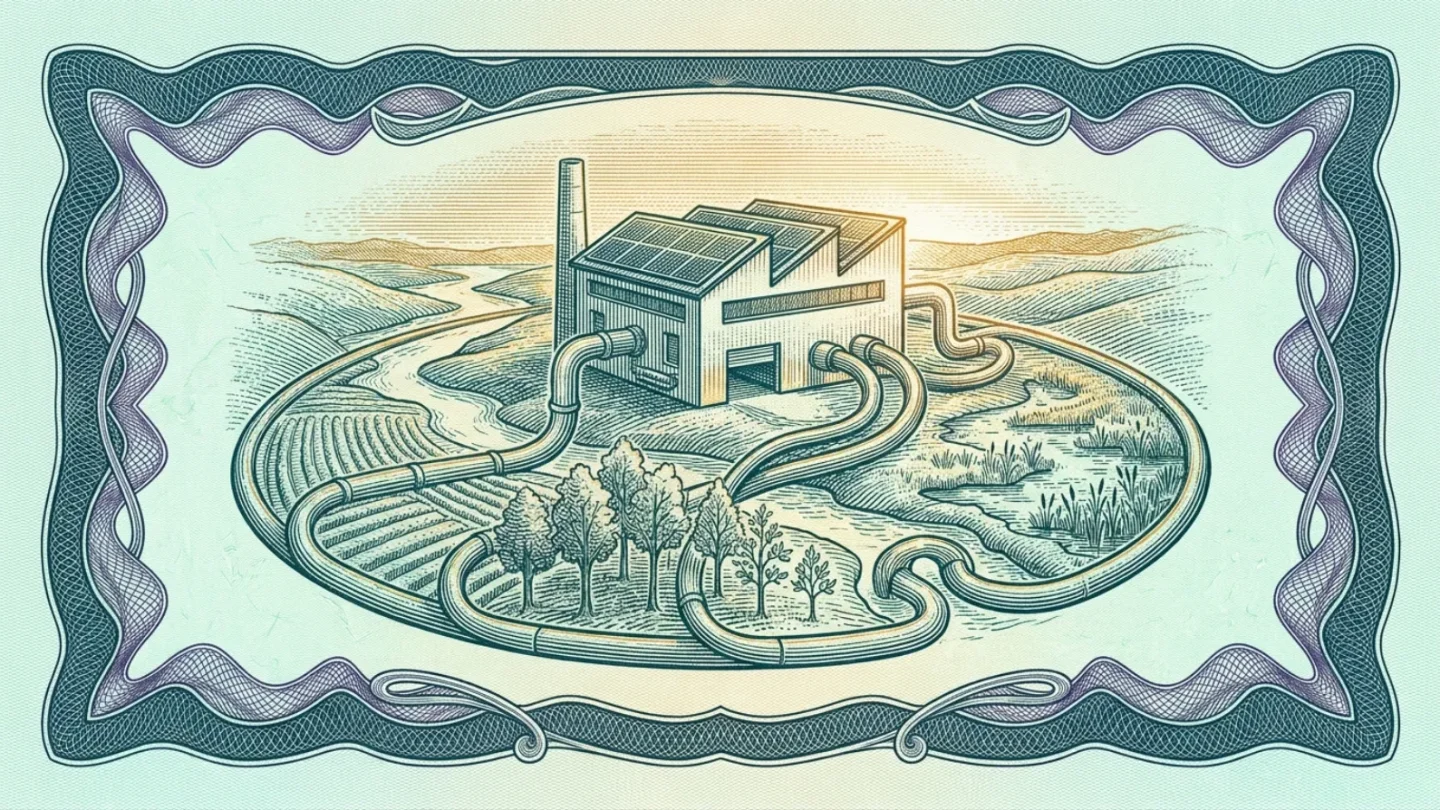
A company balance sheet lists machines, buildings and cash. It almost never lists the aquifer a factory pumps from or the forest that keeps a supplier’s river clean. Natural capitalism starts from that blind spot. It asks what would change if business treated nature as capital worth protecting, and whether that could also pay.
The problem natural capitalism tries to solve
The term comes from the 1999 book *Natural Capitalism: Creating the Next Industrial Revolution* (Little, Brown) by Paul Hawken, Amory Lovins and L. Hunter Lovins. A synopsis, “A Road Map for Natural Capitalism,” ran in the *Harvard Business Review* the same year. The Lovinses had co-founded the Rocky Mountain Institute, today called RMI.
The authors argue that an economy needs all forms of capital to work: financial capital, manufactured capital such as factories and roads, human capital (skills, knowledge, organization) and natural capital, meaning natural resources and the living systems people depend on. Industrial capitalism, in their account, counts money and machines carefully but treats nature and human capital as free. Pollination, clean water and fertile soil carry no price, so they get used up rather than maintained.
One of the authors’ core assumptions reads: “The limiting factor to future economic development is the availability and functionality of natural capital.” Because there are no known substitutes for many services that nature provides, they see running them down as a bad trade even in plain economic terms. Our explainer on money versus real wealth looks at a related confusion.
The four principles of natural capitalism
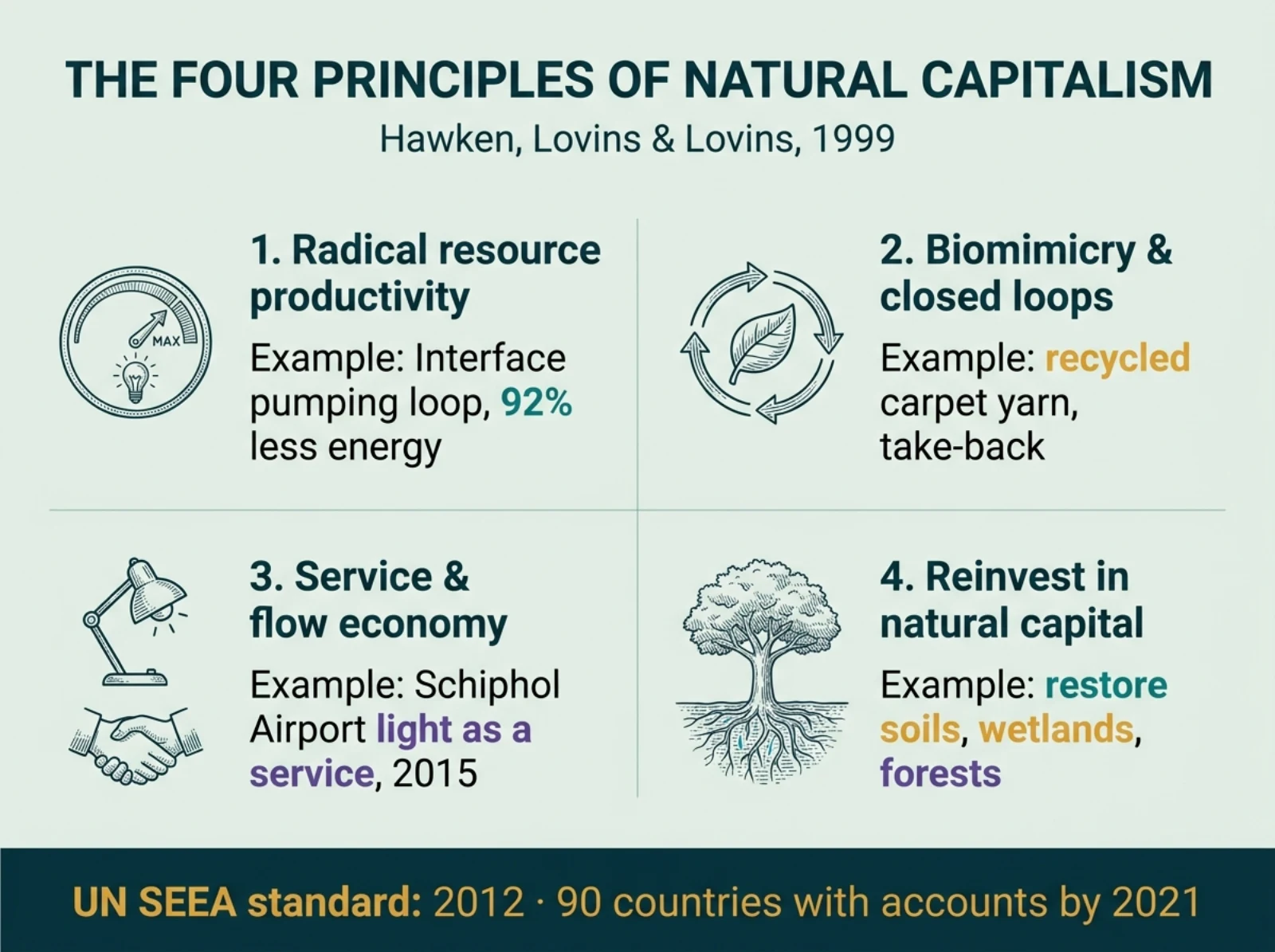
Hawken and the Lovinses propose four linked shifts in business practice. In the authors’ view they reinforce each other, and savings from the first can pay for the other three.
| Principle | What it means | Typical example |
|---|---|---|
| 1. Radical resource productivity | Get far more value from each unit of energy, water and materials | Redesigned pumps, efficient buildings, “negawatts” (saved electricity sold like a product) |
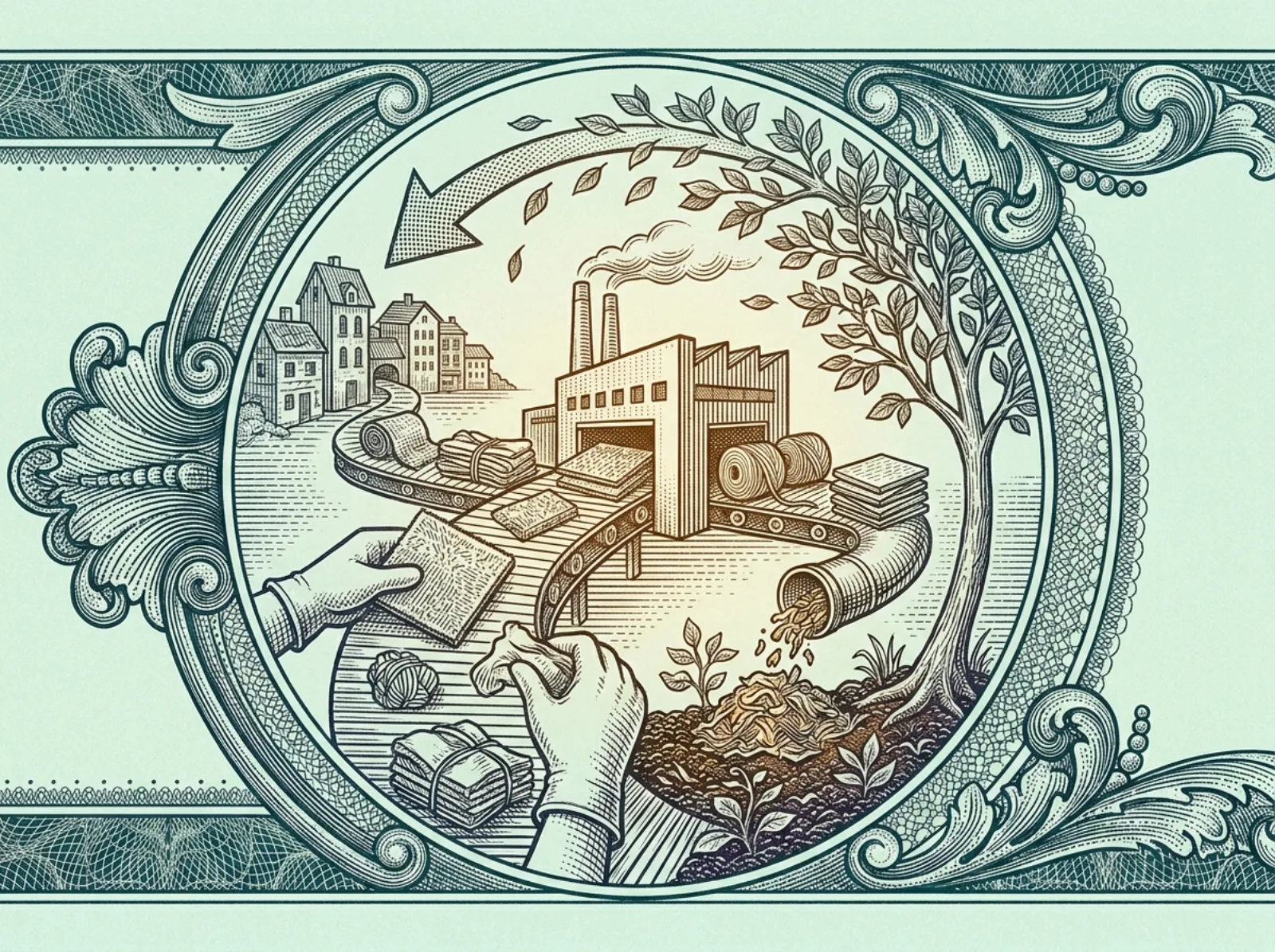
| 2. Biomimicry and closed loops | Design production like an ecosystem, where every output feeds another process | Recycled carpet yarn, take-back programs |
| 3. Service and flow economy | Sell the result (light, a clean floor) instead of the object | Lighting or flooring leased for a monthly fee |
| 4. Reinvest in natural capital | Restore the soils, waters and forests that people and business depend on | Rebuilding soils, restoring wetlands and forests |
Increased resource productivity gets the most space. The authors point out, for example, that a car turns only about 1% of its fuel energy into moving the driver, and they argue that whole-system design (fatter pipes, smaller pumps, better windows) can cut resource use sharply at a profit. The service and flow model changes who pays for waste and repair costs: if the maker keeps owning the product, a short-lived or wasteful design costs the maker.
Where natural capitalism works in practice
Interface: from Mission Zero to Climate Take Back
The carpet-tile maker Interface is the company most often cited as a working example. Founder Ray Anderson set long-range sustainability targets in 1994, and the company’s Mission Zero aimed to eliminate its negative environmental impact by 2020. In November 2019 Interface announced it had met the goal early. By its own count, through 2018 the program brought:
- a 69% smaller carbon footprint for its carpet tile products,
- 89% less water used per unit of production,
- 92% less waste sent to landfill,
- 89% renewable energy across its factories.
The 1999 *Harvard Business Review* article also told how an Interface engineer cut the energy use of a factory pumping system by 92% with fatter pipes and smaller pumps. Under its next mission, Climate Take Back, Interface launched what it called the world’s first carbon negative carpet tile in October 2020, measured cradle to gate. Its stated goal is to become a carbon negative company by 2040.
RMI and the efficiency business case
RMI turned efficiency into consulting work. Its best-known project is the Empire State Building retrofit, planned to save 38% of the building’s energy and $4.4 million a year. In 2012 RMI reported that the building had beaten its first-year efficiency guarantee by 5%, saving $2.4 million.
Products sold as services
In April 2015 Amsterdam’s Schiphol Airport signed a “light as a service” contract with Philips. The airport pays for the light it uses, and Philips keeps ownership of the fixtures, which were expected to use about half the electricity of conventional lighting. The 1999 article sketched the same idea for carpets: a supplier leases the floor and swaps only worn tiles, since roughly 20% of a carpet takes 80% of the wear.
From idea to accounting standard
Natural capital, the stock this business strategy tries to protect, has since entered official statistics. According to the UN System of Environmental-Economic Accounting (SEEA), the UN Statistical Commission adopted the SEEA Central Framework in 2012 as the first international standard for environmental-economic accounting, and SEEA Ecosystem Accounting in 2021. By 2021, 90 countries had compiled SEEA accounts.
For companies, the Natural Capital Coalition published the Natural Capital Protocol in 2016, a framework to identify, measure and value their impacts and dependencies on nature. In 2020 the coalition merged with the Social and Human Capital Coalition to form the Capitals Coalition.
Limits and critics
Supporters see the approach as evidence that business interests and the environment can line up. Critics raise four main objections:
- Rebound effect. In *The Coal Question* (1865), economist William Stanley Jevons observed that more efficient coal use went along with more coal being burned. Today economists call this the rebound effect: when efficiency makes energy or materials cheaper, total demand can rise. How large the effect is remains debated.
- Growth. Degrowth scholars argue that efficiency inside a growing economy has not reduced global resource use in absolute terms, so consumption levels matter more. Green-growth economists reply that absolute decoupling is achievable with the right prices and policies.
- Greenwashing risk. Corporate figures are often self-reported, and claims depend on boundaries. “Cradle to gate” covers production but not use and disposal, and carbon neutral labels can rely on offsets.
- The word “capitalism.” Ecosocialist critics such as Joel Kovel argued in 1999 that this approach defends the existing system. Hawken later said he regretted the confusion over the title; he supports commerce and entrepreneurship, he explained, but not what he called the pathological traits of pure capitalism.
Defenders answer that efficiency savings show up on the bottom line and that service contracts give makers a reason to build products that last. They also point to the fourth principle, which asks companies to restore natural resources as well as cut harm. Readers comparing ownership models may also want our overview of co-ops and post-corporate business models.
What natural capitalism means today
More than 25 years on, much of this vocabulary is mainstream. The circular economy, service contracts like the one at Schiphol and natural capital accounting all echo the four principles. Hunter Lovins continues the work through Natural Capitalism Solutions. Whether efficiency can move fast enough is still open, because it does not by itself set how much carbon can still be emitted, a limit covered in our explainer on the carbon budget.
To judge a company that says it follows these ideas, ask:
- Are savings measured against a stated baseline year and checked by a third party?
- Does the claim cover the full lifecycle or only production?
- Does the company earn more from durability and service, or from selling more units?
- Does any money go back into restoring land, water or forests?
Frequently asked questions
Who wrote Natural Capitalism?
Paul Hawken, Amory Lovins and L. Hunter Lovins. Little, Brown published the book in 1999.
What is the difference between natural capital and natural capitalism?
Natural capital is the stock of resources and living systems providing ecosystem services that people rely on. Natural capitalism is a business approach that tries to protect and grow that stock while staying profitable.
Is natural capitalism the same as the circular economy?
Not quite. The circular economy overlaps mainly with the second and third principles. The 1999 framework puts radical efficiency first and adds reinvestment in natural capital.
Sources
- RMI: A Road Map for Natural Capitalism (Harvard Business Review synopsis, 1999)
- UN SEEA: Frequently Asked Questions
- Capitals Coalition: Natural Capital Protocol
- Interface: Interface Achieves Carbon Negative Milestone (press release, Oct. 20, 2020)
- RMI: Empire State Building Retrofit Surpasses Energy Savings Expectations