
About 300 tonnes of depleted uranium were fired during the 1991 Gulf War, most of it from aircraft over southern Iraq and Kuwait. Since then the metal has been described as everything from harmless scrap to a slow-acting poison. Veterans, residents of former conflict zones and international agencies have all weighed in, often with conflicting conclusions.
This explainer tests six common claims about depleted uranium (DU) against what health and environmental bodies have published, and flags where the evidence is thin or contested.
Claim 1: “Depleted uranium is just harmless leftover metal”
Verdict: Partly true. DU is what remains after natural uranium is enriched for reactor fuel or weapons. Enrichment concentrates the fissile isotope uranium-235, and the leftover is mostly uranium-238. The US Nuclear Regulatory Commission defines DU as uranium with less than 0.711 percent U-235; military material typically contains 0.2 to 0.3 percent.
“Leftover” is accurate. “Harmless” is not. DU is still a heavy metal and still mildly radioactive, around 40 percent less radioactive than natural uranium.
| Property | What it means |
|---|---|
| Source | By-product of uranium enrichment; the US Department of Energy reported some 480,000 tonnes in storage in 2002 |
| Density | 19.1 g/cm³, roughly 1.7 times as dense as lead |
| Radiation type | Mainly alpha particles, which do not pass through skin |
| Civilian uses | Aircraft counterweights, radiation shielding, containers for radioactive materials |
| Military uses | Armor-piercing tank and aircraft ammunition, tank armor |
Density is why the military uses it. A DU penetrator stays sharp as it pierces armor, and on impact it can burn into fine dust, which is where most health questions begin.
Claim 2: “The radiation is the main danger”
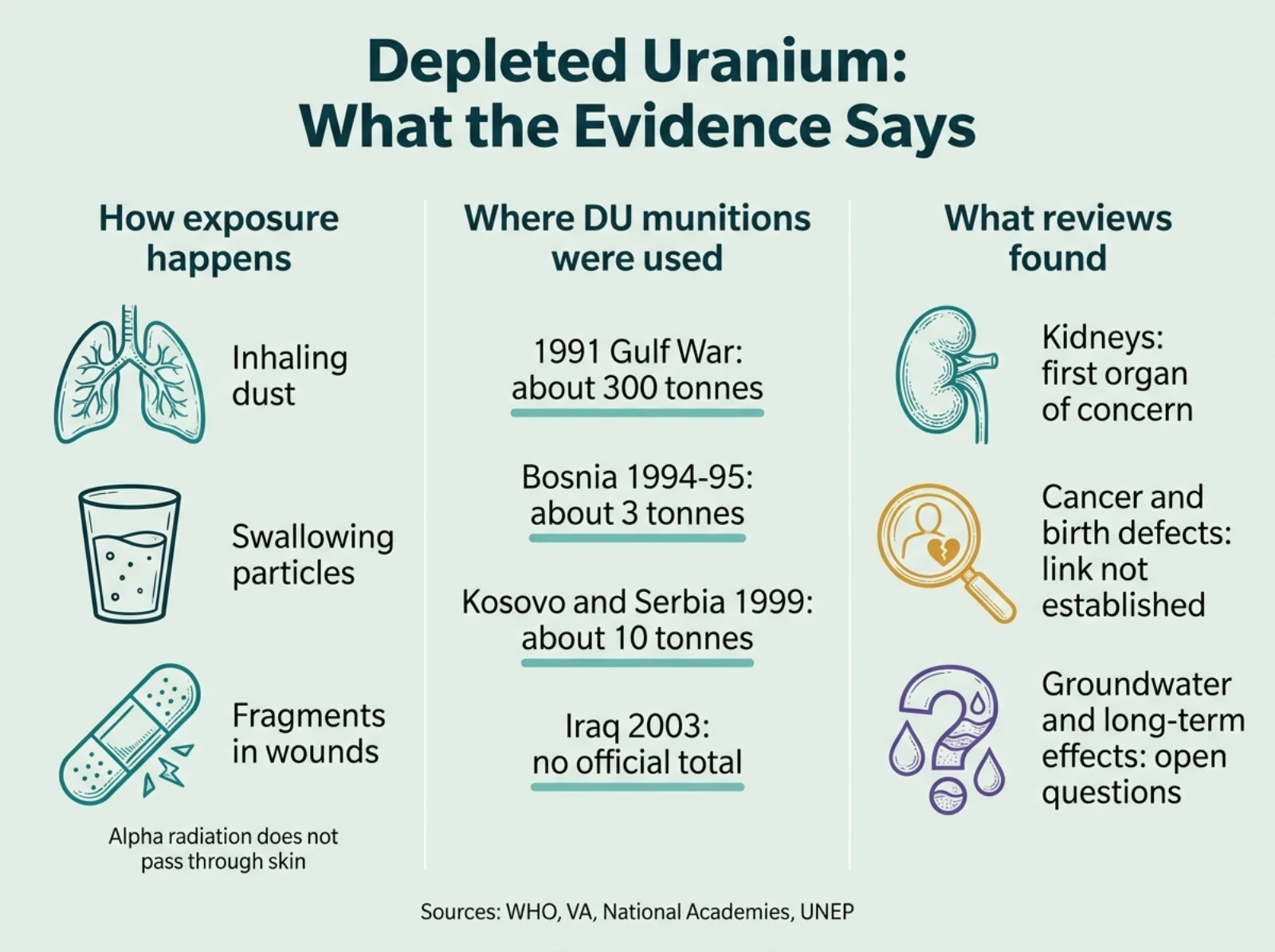
Verdict: Mostly not, according to the agencies that have studied it. The EPA explains that alpha radiation from DU outside the body is not considered a serious hazard because skin and clothing stop it. If particles are inhaled, swallowed or lodged in a wound, which may happen when a round burns on impact, DU acts as both a toxic chemical and an internal radiation source.
The US Department of Veterans Affairs (VA) names the kidneys as the first organ of concern, since uranium is a heavy metal and the kidneys filter it from the blood. The International Atomic Energy Agency has likewise described chemical toxicity, not radioactivity, as the usual dominant concern.
The World Health Organization’s 2001 review concluded that DU can have chemical and radiological effects, but exposure “would have to be significant” before any health effects are observed. You can read WHO’s current summary on its depleted uranium page.
Who could plausibly reach significant exposure?
- soldiers inside or near vehicles struck by DU rounds, including in friendly fire incidents
- rescuers and salvage crews entering burning or damaged vehicles
- people near fires in ammunition stores
- children playing at impact sites, whom WHO singled out for monitoring and prevention
Claim 3: “DU munitions contaminated entire regions”
Verdict: The measurements point to local hot spots, with open questions about groundwater. Known uses of DU munitions in conflict include these campaigns:
| Conflict | Estimated DU fired | Notes |
|---|---|---|
| 1991 Gulf War | roughly 300 tonnes | UNEP; peer-reviewed studies |
| Bosnia and Herzegovina, 1994–95 | around 3 tonnes | estimate cited in a European Parliament study |
| Kosovo and Serbia, 1999 | around 10 tonnes | same study |
| Iraq, 2003 | no complete official total | published estimates vary widely; the UK reported 1.9 tonnes fired by its own forces |
Between 1999 and 2003 the United Nations Environment Programme (UNEP) assessed targeted sites in Kosovo, Serbia and Montenegro, and Bosnia and Herzegovina. For Kosovo, UNEP reported no cause for alarm over radiation risks. It still recommended precautions: clearing penetrators, marking sites and monitoring drinking water. Its 2002 Serbia and Montenegro study described DU contamination at the sites as widespread but low level. Team members stressed scientific uncertainty, especially about buried penetrators slowly corroding into groundwater. In Iraq, UNEP later trained staff of the national Radiation Protection Center and handed over a database of DU sites for cleanup planning.

Our explainer on mycoremediation, the use of fungi to clean polluted soil covers one biological cleanup method researchers test on heavy metals.
Claim 4: “Depleted uranium caused Gulf War illness”
Verdict: Current evidence points away from DU as the main cause. Gulf War illness is a chronic condition with many symptoms, among them fatigue, pain, memory problems, digestive and skin complaints, reported by a large share of those who served in 1990–91. Many suspected DU early on, and some, including former Army personnel who had worked on DU cleanup, have publicly attributed their own illnesses to it.
Researchers have tested the idea several ways:
- In 2000 the Defense Department’s Office of the Special Assistant for Gulf War Illnesses concluded that DU exposure was unlikely to explain the undiagnosed illnesses reported by veterans.
- In 2008 the VA’s Research Advisory Committee on Gulf War Veterans’ Illnesses judged DU not likely to be a primary cause of Gulf War illness for most veterans.
- In 2021 a study in *Scientific Reports* by researchers at the University of Portsmouth and UT Southwestern tested urine from 154 veterans with high-sensitivity mass spectrometry. It found no DU signature in any sample, from ill and healthy participants alike. The authors named organophosphates, meaning pesticides and low levels of sarin nerve agent, as the more likely cause.
Some veterans’ groups and independent researchers argue that early exposures were never measured properly, and urine tests taken decades later cannot fully reconstruct them. The debate over causes continues.
Claim 5: “DU causes cancer and birth defects”
Verdict: Not established, and still argued over. The National Academies’ Institute of Medicine reviewed uranium studies in 2000 and again in 2008. The 2008 committee found limited or suggestive evidence of *no* association between uranium and two outcomes: lung cancer at lower internal doses, and clinically significant kidney damage. For most other outcomes, including bone and lymphatic cancers and nervous system disease, it said the evidence was insufficient to decide. Overall, it said the evidence could not yet show whether DU exposure causes long-term health problems.
The United Nations Scientific Committee on the Effects of Atomic Radiation (UNSCEAR) reviewed the literature in its 2018 report. As summarized by WHO, it found no convincing evidence linking DU exposure with clinical outcomes, including cancer and congenital malformations, while noting the limits of the available studies.
Household surveys and hospital studies in Fallujah published from 2010 onward reported high rates of birth defects and childhood cancer, and some authors pointed to war-related contaminants, uranium among them. Critics questioned the survey methods, and the studies could not show a cause. A 2013 summary by Iraq’s Ministry of Health and WHO, covering 18 districts, reported no clear evidence of unusually high birth-defect rates. Other scientists criticized its methods and its omission of possible causes.
Claim 6: “Exposed veterans are simply left on their own”
Verdict: Not in the US. Since 1993 the VA has run a Depleted Uranium Follow-Up Program at the Baltimore VA Medical Center for veterans with embedded fragments or heavy exposure. Some participants still carry fragments that surgeons could not safely remove, and they excrete more uranium than people without fragments. As of October 2026, the VA states there is no evidence of long-term health effects from embedded DU fragments, and it continues to watch kidney function and bone density.
Anyone who served and is concerned about exposure to depleted uranium can ask for screening through a VA environmental health coordinator or primary care team. For the claims process itself, see our guide to veterans’ benefits.
Questions that remain open
What are the main depleted uranium health effects?
Agencies list kidney damage from the chemical toxicity of uranium as the best-supported risk after heavy internal exposure. Links to cancer and birth defects have been reported but not established in human studies, and some researchers dispute that conclusion.
Why is the debate not settled?
Exposures in war zones were rarely measured when they happened, and people often faced many pollutants at once. Those gaps make clear answers hard to reach in either direction.
*This article is general information, not medical or legal advice. Veterans and residents with health concerns should talk to a physician.*
Sources
- WHO: Depleted uranium (Radiation and health)
- U.S. Department of Veterans Affairs: Depleted Uranium
- National Academies: Gulf War and Health: Updated Literature Review of Depleted Uranium (2008)
- Parrish & Haley, Scientific Reports (2021): Resolving whether inhalation of depleted uranium contributed to Gulf War Illness
- U.S. EPA RadTown: Depleted Uranium (archived)