
A day laborer in first-century Galilee stands in front of a man with more land and standing than he will ever have. The landowner strikes him on the right cheek with the back of his right hand. It is the slap you give an inferior. The laborer can hit back and probably lose everything. He can lower his eyes and take it. Or he can do something stranger: look up and turn his head, offering the left cheek.
That scene is at the center of Walter Wink’s third way, one of the most quoted readings of the Sermon on the Mount among people who teach nonviolence. Wink argued that the sayings in Matthew 5 describe neither surrender nor revenge. He read them as short scripts for keeping your human dignity when someone holds power over you.
Who was Walter Wink?
Wink (1935–2012) was an American New Testament scholar and United Methodist minister from Dallas. After a doctorate and teaching at Union Theological Seminary, he became Professor of Biblical Interpretation at Auburn Theological Seminary in New York City in 1976 and retired as professor emeritus in 2005.
His best-known work is the “Powers” trilogy. It reads the biblical “principalities and powers” as a way to talk about institutions and the spirit that drives them. He later condensed it for general readers in *The Powers That Be*:
- *Naming the Powers* (1984)
- *Unmasking the Powers* (1986)
- *Engaging the Powers: Discernment and Resistance in a World of Domination* (1992)
He set out his reading of Jesus in two shorter books, *Violence and Nonviolence in South Africa: Jesus’ Third Way* (1987) and *Jesus and Nonviolence: A Third Way* (2003). He also coined the phrase “the myth of redemptive violence,” was a Peace Fellow at the United States Institute of Peace in 1989–1990, and received the Martin Luther King Jr. Peace Prize from the Fellowship of Reconciliation.
The three sayings, read in their first-century setting
The passage is short. In the New Revised Standard Version, Matthew 5:38–41 reads: “You have heard that it was said, ‘An eye for an eye and a tooth for a tooth.’ But I say to you, Do not resist an evildoer. But if anyone strikes you on the right cheek, turn the other also; and if anyone wants to sue you and take your coat, give your cloak as well; and if anyone forces you to go one mile, go also the second mile.” A few verses later comes the command to love your enemies.
Many readers have taken these lines as advice to be passive in the face of evil. Wink read each case as a move by someone with little power against someone with a lot of it.
| Saying | The situation, as Wink reconstructs it | What the response does, in his reading |
|---|---|---|
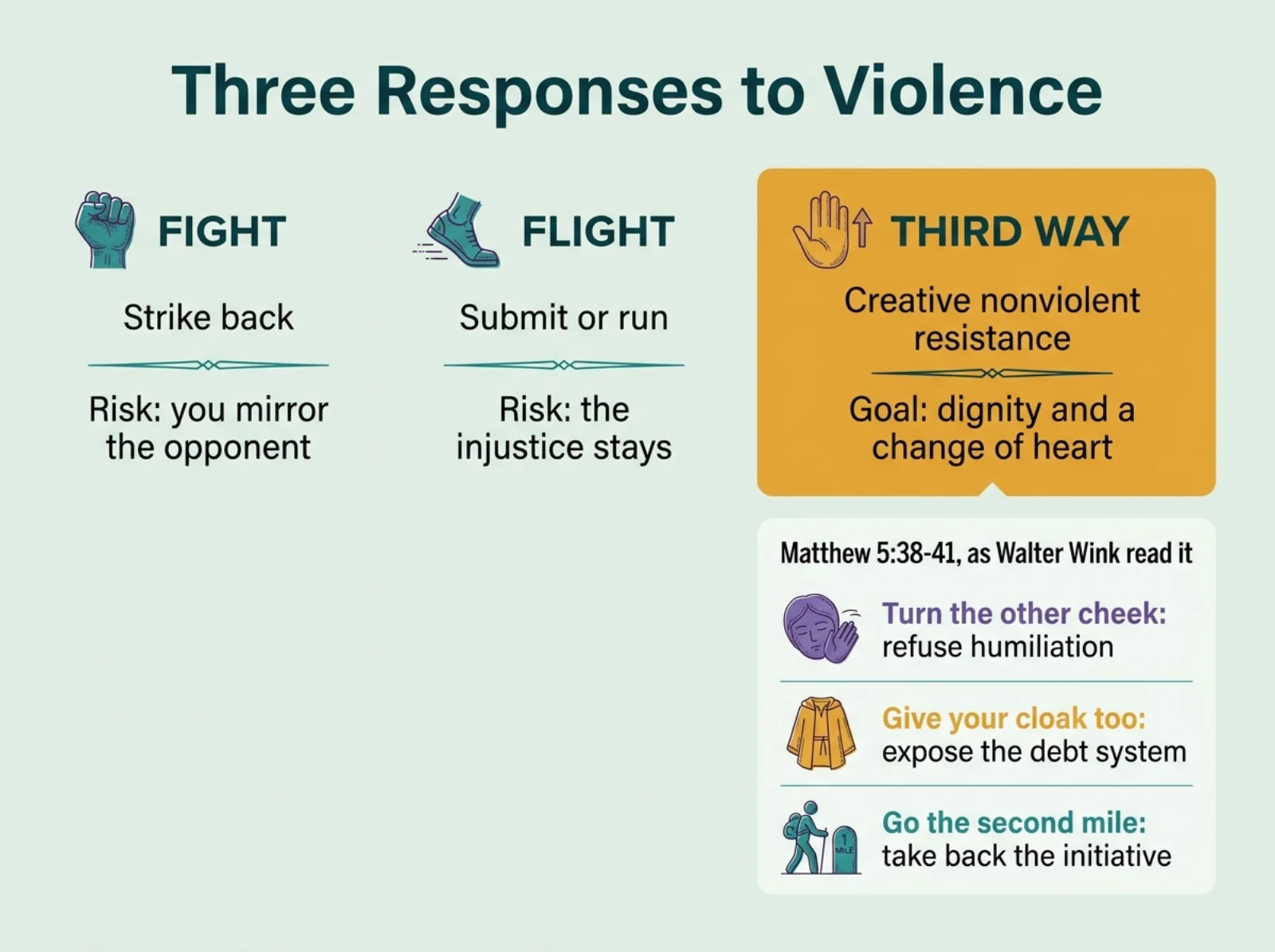
| Turn the other cheek | A superior backhands an inferior | The left cheek invites a forehand blow, the blow between equals, and refuses the humiliation |
| Give your cloak as well | A poor debtor is sued for his outer garment | Handing over the undergarment leaves him naked, and the shame falls on the creditor and the debt system |
| Go the second mile | A Roman soldier makes a civilian carry his pack | Carrying it past the legal limit puts the soldier in breach of his own rules and takes back the initiative |
He also argued that the Greek verb in “do not resist an evildoer” (*antistēnai*) usually meant resisting by force.
Some ancient evidence supports the idea that a backhand insulted more than an ordinary blow. The Mishnah, the early rabbinic law code, sets damages for humiliation at 200 dinars for a slap and 400 if it was given with the back of the hand (Mishnah Bava Kamma 8:6 on Sefaria). Wink used details like this to argue that Jesus’ first listeners would have caught the social meaning.

Fight, flight, or something else
Wink’s starting point was that people facing violence usually see two responses. They can fight back, which risks copying the enemy, or they can give in and run. He described Jesus’ alternative as “neither cowardly submission, nor violent reprisal.”
Across his books and workshop talks such as *Nonviolence for the Violent*, the approach comes down to a handful of moves that read like a training checklist:
- Seize the moral initiative instead of reacting on the opponent’s terms.
- Find a creative alternative to violence.
- Assert your own dignity and expose the injustice so others can see it.
- Take the law and push it to the point of absurdity.
- Refuse to become the thing you oppose, and aim at the opponent’s change of heart.
He liked to tell of women in a South African squatter camp who, facing demolition shortly before apartheid ended, stripped in front of the bulldozers until the police backed off. He also cited Gene Sharp’s catalog of 198 methods of nonviolent action (1973) to show that the options go far beyond marching.
How the idea traveled into movements
Wink wrote for a specific crisis. He spent 40 days in South Africa in March and April 1986 and led four workshops on Jesus’ teaching on nonviolence. The book he wrote afterwards appeared in 1987, published in cooperation with the Fellowship of Reconciliation.
The South African theologian Dion Forster, who was trained in those workshops as a Methodist, writes that Wink helped shape the Methodist Church of Southern Africa’s work as a “peace church,” a commitment the church made in 1988. Forster’s account is personal and supportive, one participant’s view of the influence.
Since then the framework has turned up in church study groups, seminary courses and nonviolence workshops. For other routes into public life, see our guide to civic participation. Our account of the Battle of Seattle in 1999 shows how hard it can be to agree on tactics in a large protest.
What critics say about Wink’s reading
Wink’s reading has drawn steady criticism from scholars and ethicists, often from people who share his concern that Jesus’ words should not be used to excuse abuse. A 2021 symposium on his book at the Political Theology Network collects several of these arguments.
- Ethicist Kevin Carnahan argued that the cultural settings Wink describes are not in the text and do not appear elsewhere in the Gospels. He called it “the kind of exegesis that would get failed in a historical-critical Bible class,” while granting that it “has succeeded because it is good ethics.”
- Carnahan also notes that Wink shows no passage where *antistēnai* separates violent from nonviolent resistance.
- Joseph Scrivner asks why a Roman soldier would not simply say the peasant volunteered for the second mile, and argues that the response can look the same as passivity from the outside.
- The Roman rule limiting forced carriage to one mile is usually cited from the Theodosian Code, a collection compiled in the 430s, centuries after Jesus.
- Commentator John Nolland concluded that the saying is not necessarily an endorsement of any one social or political strategy, and Jonathan Pennington reads the passage as ethical wisdom rather than a new legal rule.
Wink has defenders too. In the same symposium, ethicist Scott Paeth called his work “an excellent example of constructive Biblical theology,” arguing that Wink was applying the text to modern problems more than reconstructing history. Amy-Jill Levine and Marc Brettler, writing in 2020, also read *antistēnai* as armed resistance and see the turned cheek as a way to keep honor without escalating.
Questions readers ask
What is the myth of redemptive violence?
It is Wink’s term for the belief that violence saves, that order comes from defeating chaos or the enemy by force. He traced the story from ancient Babylon to modern media and set the teaching of Jesus against it.
Was Jesus a pacifist?
Christians have never agreed on this. Pacifist traditions, including the historic peace churches, read Matthew 5 as ruling out violence. Just war traditions hold that force can be justified under strict conditions. Wink held that Jesus taught active nonviolent resistance, which he set apart from passivity.
Is the idea only for Christians?
No. Wink drew on Gandhi and on secular strategists like Gene Sharp, and many people use the framework without any religious commitment.
Sources
- Sefaria: Mishnah Bava Kamma 8:6
- Hartford International University: Hartford Seminary Community Mourns the Deaths of James Fengahen, Walter Wink
- Lutheran Peace Fellowship: Transcript of Walter Wink's Nonviolence for the Violent
- Political Theology Network: Walter Wink's Blind Spot: Passivity as Resistance (Joseph Scrivner, 2021)
- Oxford Institute of Methodist Theological Studies: Dion Forster, A politics of peace and justice? Walter Wink's engagement with Matthew 5:38-42