
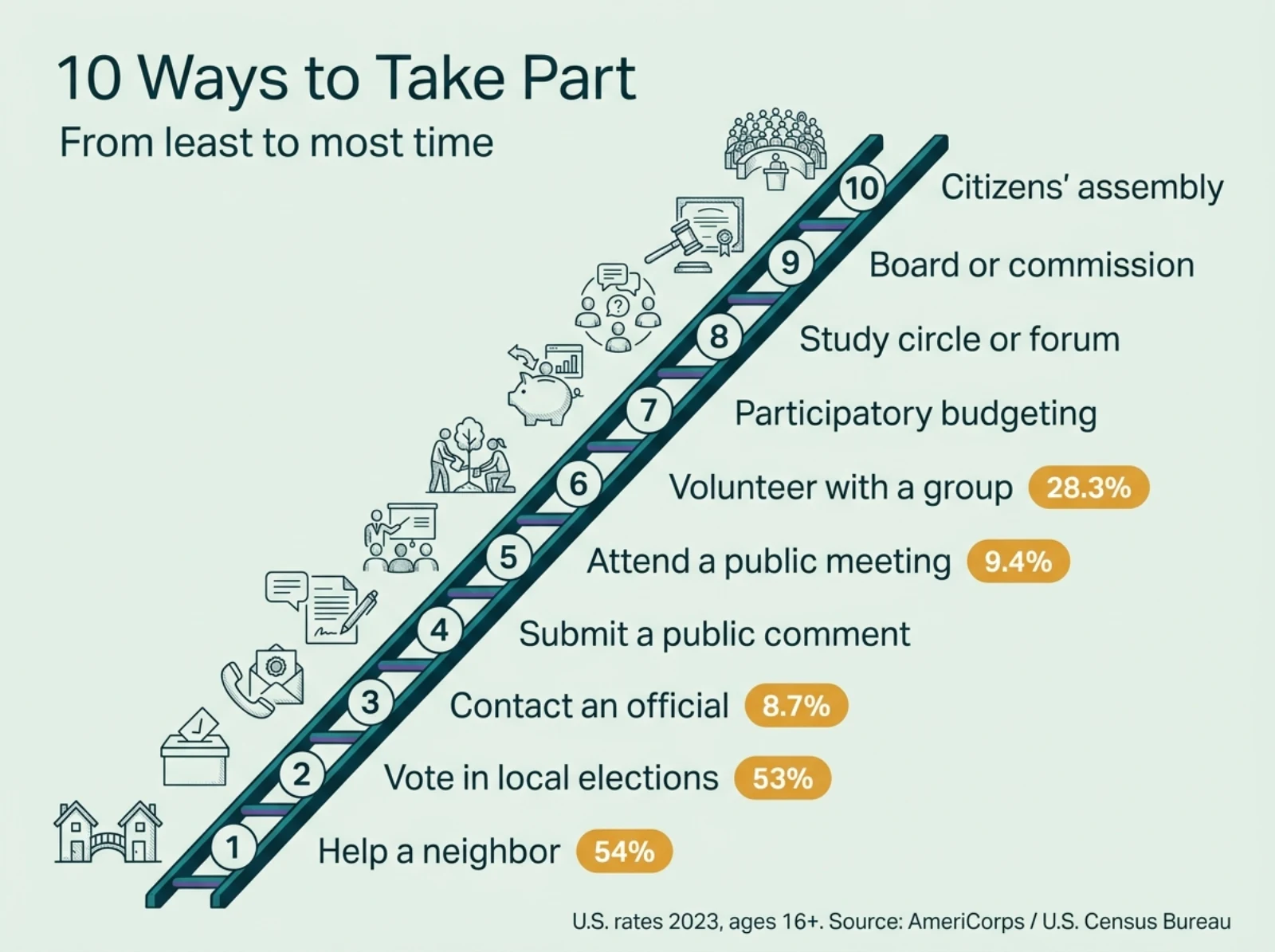
In September 2023, fewer than one in ten Americans aged 16 and older said they had attended a public meeting in the past year. More than half had done a favor for a neighbor. That gap, measured by the U.S. Census Bureau and AmeriCorps, says a lot about civic engagement in the United States: individuals help each other all the time, but far fewer show up where community decisions get made.
This guide lists ten civic activities that can help your community, ordered from the smallest commitment to the largest. For each one you get what it is, a real example and a place to start; the table adds the time it takes. Every activity is open to people of any party or none.
What civic engagement means
Civic engagement covers the ways individuals and groups act on issues of public concern and the needs of the community. Some activities are political, such as voting. Others are social, such as running a food pantry or coaching a youth team. Political scientists add a related idea, social capital: the trust and networks that make it easier for people within a community to work together. “Civic participation” usually means the narrower, government-facing part: elections, hearings, advisory boards. In everyday use the two terms overlap.
There are four broad kinds of civic activities:
- helping others directly (informal helping, volunteering, community service)
- shaping decisions (voting, public comment, serving on boards)
- deliberating with others (forums, study circles, citizens’ assemblies)
- learning and talking about issues (local news, civic education in schools, civic learning at colleges and universities, social media)
Ten civic activities at a glance
| # | Activity | Typical time | Where to start |
|---|---|---|---|
| 1 | Help a neighbor | Minutes | Your street or building |
| 2 | Register and vote | 15 minutes, then a few hours per election | vote.gov, state election office |
| 3 | Contact an official | 15–30 minutes | City or county website |
| 4 | Submit a public comment | 30–60 minutes | Meeting agendas, regulations.gov |
| 5 | Attend a council or school board meeting | 2–3 hours | Meeting calendars |
| 6 | Volunteer with an organization | 2–4 hours a month | Food banks, libraries, Idealist |
| 7 | Join participatory budgeting | A few hours per cycle | Your city’s PB page |
| 8 | Join a study circle or forum | 4–10 hours over weeks | Everyday Democracy, National Issues Forums Institute |
| 9 | Serve on a board or commission | Monthly, 1–4 years | City clerk’s vacancy list |
| 10 | Serve on a citizens’ assembly | Several weekends | Random invitation |
1. Help a neighbor
Watching a child, lending tools, checking on an older resident. The census survey calls this informal helping, and 54 percent of Americans 16 and up did it in 2023. It is the most common civic activity in the data, and no organization is needed. About 70 percent also said they talk to neighbors. Those everyday ties are the social capital that community projects can grow from.
2. Register and vote
Registration takes about fifteen minutes. USA.gov sends you to vote.gov, where you pick your state and see whether you can register online, by mail or in person, and what the deadlines are. Local elections decide school boards and ballot measures. In 2023, about 53 percent of survey respondents said they vote in local elections. Many counties also hire poll workers through the election office.
3. Contact an official
A short email to a council member about a pothole, a zoning change or a bus route counts. Only 8.7 percent reported contacting a public official in 2023. A specific request with a street name and a date tends to get a specific reply.
4. Submit a public comment
Many city councils and planning commissions set aside time for comment, in person or in writing. Federal agencies generally take comments on proposed rules, and regulations.gov lists open dockets. A useful comment explains how a proposal affects you and adds facts the agency may lack.
5. Attend a council or school board meeting
These sessions are generally open, and many are streamed. In 2023, 9.4 percent said they had attended one. Pick one body, read the agenda first, and the next meeting will make far more sense.

6. Volunteer with an organization
Formal volunteering means giving time through a group: a food bank, a literacy program, a park cleanup, a health clinic. About 75.7 million people, or 28.3 percent of Americans 16 and older, did so between September 2022 and September 2023, according to the AmeriCorps and Census Bureau volunteering data, up from 23.2 percent in 2021. Idealist (which now hosts VolunteerMatch) lists openings, and many colleges and universities promote civic engagement through service-learning courses that include community service. A food co-op or a community currency project is another way in.
7. Join participatory budgeting
Residents propose projects, then vote on how to spend part of a public budget. The method began in Porto Alegre, Brazil, in 1989; New York City’s Civic Engagement Commission says it has since been used more than 11,600 times worldwide. In New York, council members have run district processes since 2011, and the citywide program The People’s Money funded 46 projects worth $5 million in its first cycle in 2022, many on youth programs and mental health. Paris has run its budget participatif since 2014: by the city’s count, 23,912 ideas, 1,345 projects voted on and more than 3,500 completed works.
8. Join a study circle or deliberative forum
A study circle is a small group, often 8 to 12 people, that meets several times with a facilitator to talk through a community issue and agree on next steps. Everyday Democracy, a nonprofit in West Hartford, Connecticut, that grew out of the study circles movement, coaches communities to run them. The nonpartisan National Issues Forums Institute publishes issue guides that set out several options, so a group can weigh tradeoffs. Participating can help individuals hear neighbors whose political views differ from their own. Curious where you stand beyond left and right? Try our new political compass.
9. Serve on a board or commission
Cities rely on residents to sit on library boards, parks commissions and advisory committees, which provide recommendations to elected officials. Terms often run one to four years with monthly meetings, and the city clerk usually posts vacancies. It is a direct way to shape local government without running for office.
10. Serve on a citizens’ assembly
A citizens’ assembly brings together a randomly selected, representative group to study an issue, hear experts and make recommendations. Ireland has held six since 2013. Its 2016–2018 assembly of 99 members considered the Eighth Amendment, among other topics, and a referendum followed in 2018; later assemblies covered gender equality, biodiversity loss and drug use. The OECD counted 289 such processes between 1986 and 2019 and called the trend a “deliberative wave.” You cannot sign up; you wait for an invitation.
Benefits and limits: what supporters and critics say
Supporters argue that being civically engaged builds trust and social capital, brings local knowledge into decisions and teaches skills a democratic society depends on. They see the spread of participatory budgeting and citizens’ assemblies as evidence that the methods can help governments.
Critics name practical limits:
- Participation skews toward people with spare time and money, so a meeting may not reflect the whole community.
- Participatory budgets usually cover a small share of spending.
- Citizens’ assemblies are advisory, and governments can set their recommendations aside.
- Some scholars question whether randomly chosen members carry the mandate of elected officials.
Much of the debate turns on design: outreach, stipends, childcare and clear follow-up on what happens to residents’ input. For the economic side of community work, see our guide to building a local economy.
Frequently asked questions
What is the difference between civic engagement and civic participation?
Civic engagement is the broad term and can include volunteering, community service and helping neighbors. Civic participation usually means voting, public comment, meetings and boards.
How can I get involved in my community with little time?
Start with the first five activities above; they fit around work and family. Registering to vote, sending a comment or attending one meeting each takes an hour or so.
When will new U.S. data on civic life come out?
AmeriCorps and the Census Bureau fielded the next survey in September 2025 and announced a 2026 release. As of October 2026, the 2023 figures used here were the most recent we could confirm.