Bernard Lietaer helped build the machinery behind Europe’s single currency, then spent the second half of his career arguing that relying on one kind of money is a design flaw. He had worked inside a central bank and a currency fund, so even skeptics of his ideas about the financial system knew he understood how it works.
This guide treats his ideas as one framework, the monetary ecosystem model, and ends with a checklist for judging any currency design, from a town scrip to a time bank.
Who was Bernard Lietaer?
Bernard Lietaer (1942–2019) was a Belgian civil engineer and economist. He studied at the Catholic University of Leuven, continued at MIT and later taught international finance at Leuven. His biographies say that at the National Bank of Belgium he implemented the convergence mechanism of the ECU, the basket unit that preceded the euro, and served as president of Belgium’s Electronic Payment System. Late in life he was a research fellow at the Center for Sustainable Resources of the University of California, Berkeley.
| Year | Milestone |
|---|---|
| 1942 | Born in Lauwe, Belgium, on 7 February |
| 1987 | Co-founds the currency fund manager GaiaCorp |
| 1992 | Business Week calls him “the world’s top currency trader,” per his biographers |
| 2001 | First English edition of *The Future of Money: Beyond Greed and Scarcity* |
| 2003–2006 | Visiting scholar at Naropa University, Colorado |
| 2012 | *Money and Sustainability: The Missing Link*, a report to the Club of Rome’s EU Chapter |
| 2013 | *Rethinking Money*, with Jacqui Dunne |
| 2019 | Dies on 4 February |
As an author, he wrote most of his later work with others: *People Money* with Margrit Kennedy and John Rogers, the Club of Rome report with Christian Arnsperger, Sally Goerner and Stefan Brunnhuber.
What did he mean by “money is an agreement”?
His system rests on one definition from *The Future of Money*: money is “an agreement within a community to use something as a medium of exchange.” Paper, a ledger entry or an hour of babysitting all become money once people agree to accept them. Agreements can be renegotiated.
Why did Lietaer say scarcity is built into money?
In today’s money system, most new money is created by private lenders. The Bank of England put it plainly in 2014: the majority of money in the modern economy is created by commercial banks making loans. The deposit appears when the loan is made, and the central bank steers the total mainly through interest rates.
Lietaer went further. Banks create the principal but not the interest, he argued, so borrowers as a group compete for money that is always slightly scarce. In his view this system and its incentives nudge people toward competition and short-term thinking in economic life. He saw the national currency system as necessary but one-sided. Our explainer on money versus real wealth follows a related line of thought.
The monetary ecosystem model in four parts
1. Yang and yin currencies
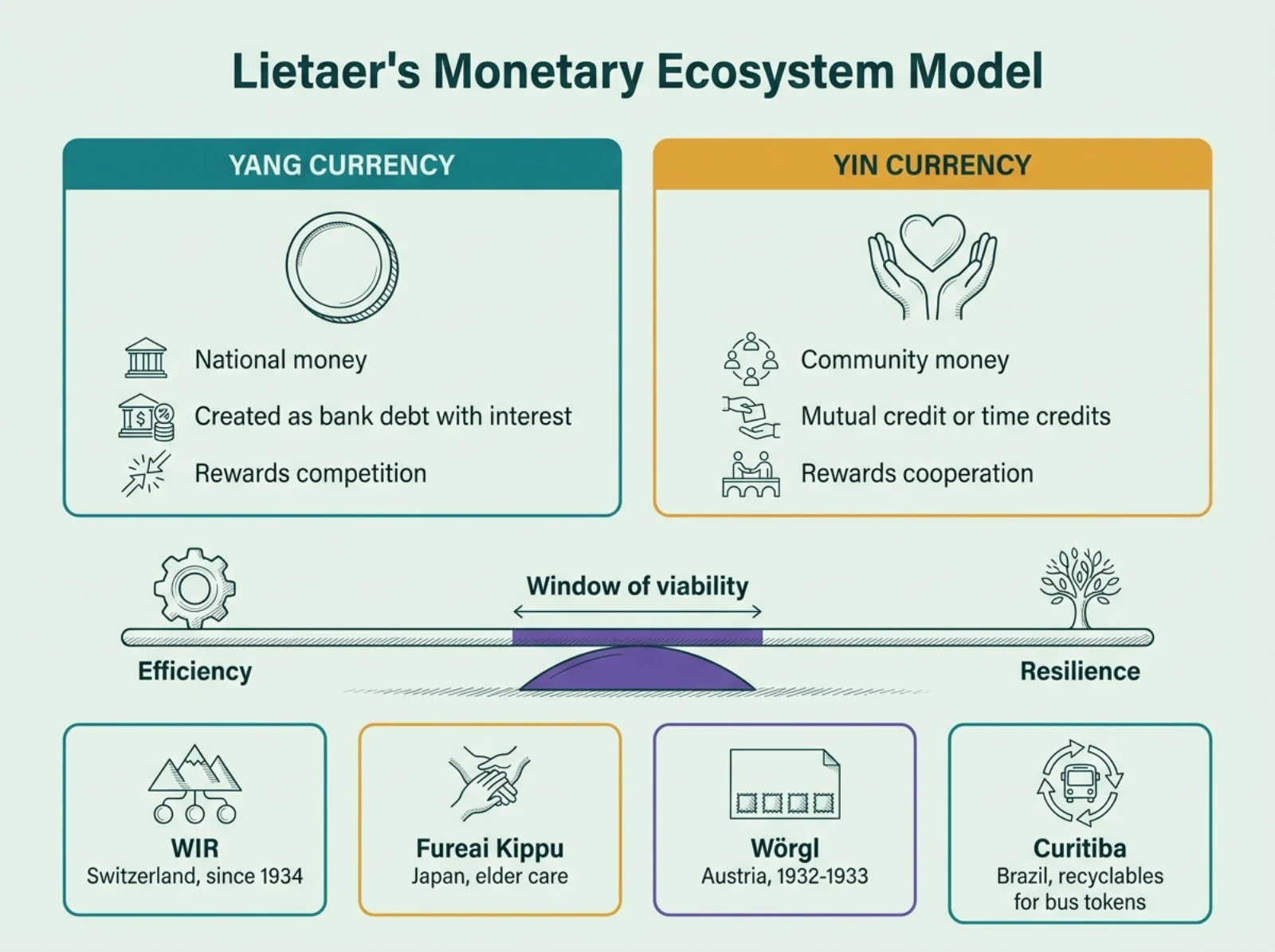
Lietaer borrowed the Chinese pairing of yin and yang for two families of money; in his model both are needed.
| Yang currency | Yin currency | |
|---|---|---|
| Typical form | National money, bank credit | Local, mutual-credit or time-based units |
| How it is created | As interest-bearing bank debt | By members, often interest-free |
| Behavior it rewards | Competition and accumulation | Cooperation and circulation |
| Strength | Efficient over long distances | Keeps local trade going in a slump |
He called yin currencies “complementary” because they are designed to run alongside the national currency instead of replacing it.
2. Efficiency versus resilience
The second part came from ecology and the science of sustainability. With the ecologist Robert Ulanowicz and the systems scientist Sally Goerner, Lietaer applied a measure from flow networks to money. Their 2010 paper in the *Journal of Futures Studies* says a sustainable system “requires a balance in emphasis between efficiency and resilience.” A network tuned only for efficiency becomes brittle; one with endless diversity stagnates. Supporters call the healthy range between them the window of viability.
3. A monoculture is fragile
The same paper concludes that “the monoculture of national currencies, justified on the basis of market efficiency, generates structural instability.” Lietaer read recurring banking and currency crises around the world as a symptom of that monoculture.
4. Purpose-built currencies
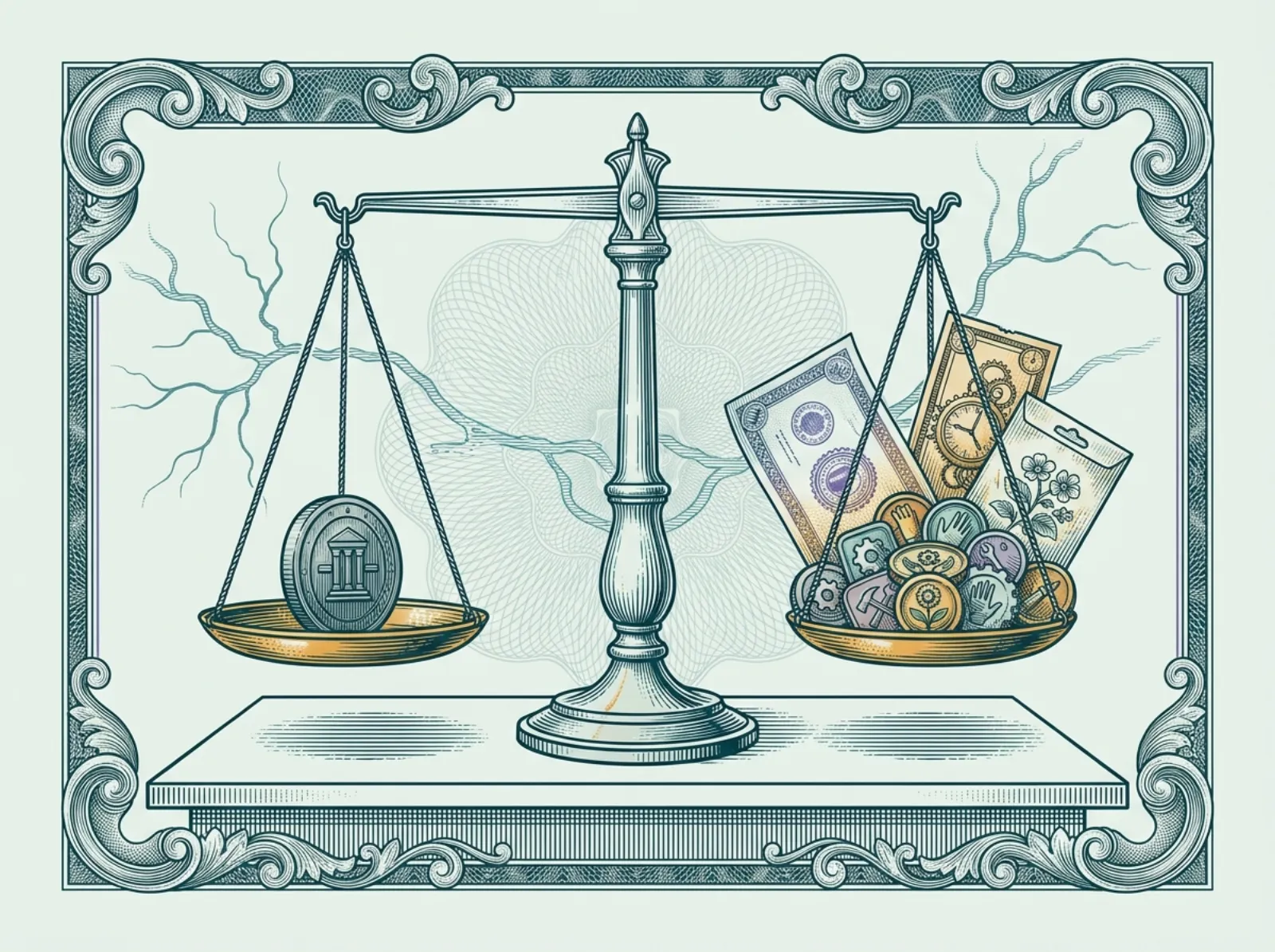
Each complementary currency should solve problems that national money handles poorly, such as paying for elder care or keeping small firms trading in a credit crunch. He compared a society with one currency to someone trying to paint with a screwdriver.
Where did Lietaer see the model working?
He returned to the same few cases in his books and talks.
- WIR, Switzerland (since 1934): a business-to-business credit network. James Stodder’s 2009 study in the *Journal of Economic Behavior & Organization* found that “unlike the ordinary money, WIR money is negatively correlated with GDP in the short run.” Firms use more of it when the economy slows.
- Fureai Kippu, Japan: volunteers earn time credits for helping older people and can save them or pass them to relatives elsewhere. Mayumi Hayashi’s 2012 study describes a slowdown after 2000, when public long-term care insurance began.
- Wörgl, Austria (1932–1933): the town paid workers in stamp scrip that lost 1 percent of its value each month, so people spent it quickly. The experiment ended in 1933 after the Austrian National Bank objected.
- Curitiba, Brazil: under Mayor Jaime Lerner, residents of poorer districts could trade sorted recyclables for bus tokens and food, which Lietaer described as a currency for environmental work.
Our guide to local currencies covers the main types and how communities launch them.
What do critics and mainstream economists say?
His ideas have been taken up mostly by community currency groups and sustainability researchers, and much less by central banks and economics departments. There are four main objections.
- The interest argument. Critics reply that interest paid to lenders flows back out as wages, dividends and spending, so it does not by itself create a lasting shortage. Positive Money, a campaign group that wants to end private money creation, made the same point in 2017.
- The ecology analogy. The philosopher Louis Larue examined Lietaer’s arguments about money and sustainability in *Alternative Currencies: A Critical Approach* (Bristol University Press, 2024) and called the theoretical underpinning of the field “deeply flawed.” A 2025 review in the *International Journal of Community Currency Research* summed up his view that these claims lack the rigor to justify the field’s enthusiasm.
- Scale. Larue also argues that small voluntary currencies change little, while large imposed ones would limit individual freedom.
- Evidence. Apart from WIR, few complementary currencies have long data series, and many local schemes fade after a few years.
Supporters answer that WIR’s countercyclical record is what the model predicts, and that resilience is hard to value until a crisis hits. Critics and supporters alike treat design and governance as the factors that decide whether a currency lasts.
Checklist: judge a currency design with Lietaer’s lens
Run your own proposal through these questions. For the practical side, see our notes on building a local economy.
- Which specific job does it do that national money does poorly?
- Does it run alongside the official currency, with clear exchange rules?
- Who issues it, and is it created as debt, as mutual credit or through time given?
- Does the design reward spending over hoarding, for example through demurrage or expiry dates?
- Would members keep using it in a recession, when ordinary cash is scarce?
- Who can change the rules, and how are members represented?
- Does it respect the central bank’s monopoly on legal tender and local tax rules? Wörgl failed on this point.
- Will it publish turnover and membership figures so its effect can be measured?
A design that clears most of these boxes comes close to what Bernard Lietaer had in mind: one more currency in a more diverse monetary ecosystem, working next to the money people already use.
Sources
- Bank of England: Money creation in the modern economy (Quarterly Bulletin 2014 Q1)
- Journal of Futures Studies: Is Our Monetary Structure a Systemic Cause for Financial Instability? (Lietaer, Ulanowicz, Goerner, McLaren, 2010)
- Journal of Economic Behavior & Organization: Complementary credit networks and macroeconomic stability: Switzerland's Wirtschaftsring (Stodder, 2009)
- International Journal of Community Currency Research: Japan's Fureai Kippu Time-banking in Elderly Care (Hayashi, 2012)
- International Journal of Community Currency Research: Book review of Alternative Currencies: A Critical Approach (Ocampo, 2025)