Between 1995 and 2020, over a quarter of all countries saw GDP per capita go up while their real wealth per capita went down. The finding, from the World Bank’s wealth accounts, sounds like a contradiction until you separate two words most of us treat as synonyms.
The difference between money and wealth looks like a personal finance topic, and it is one, but it also shapes how whole economies keep score. This guide compares the terms, shows where the gap appears in the data and what it means for a household.
Three words people mix up
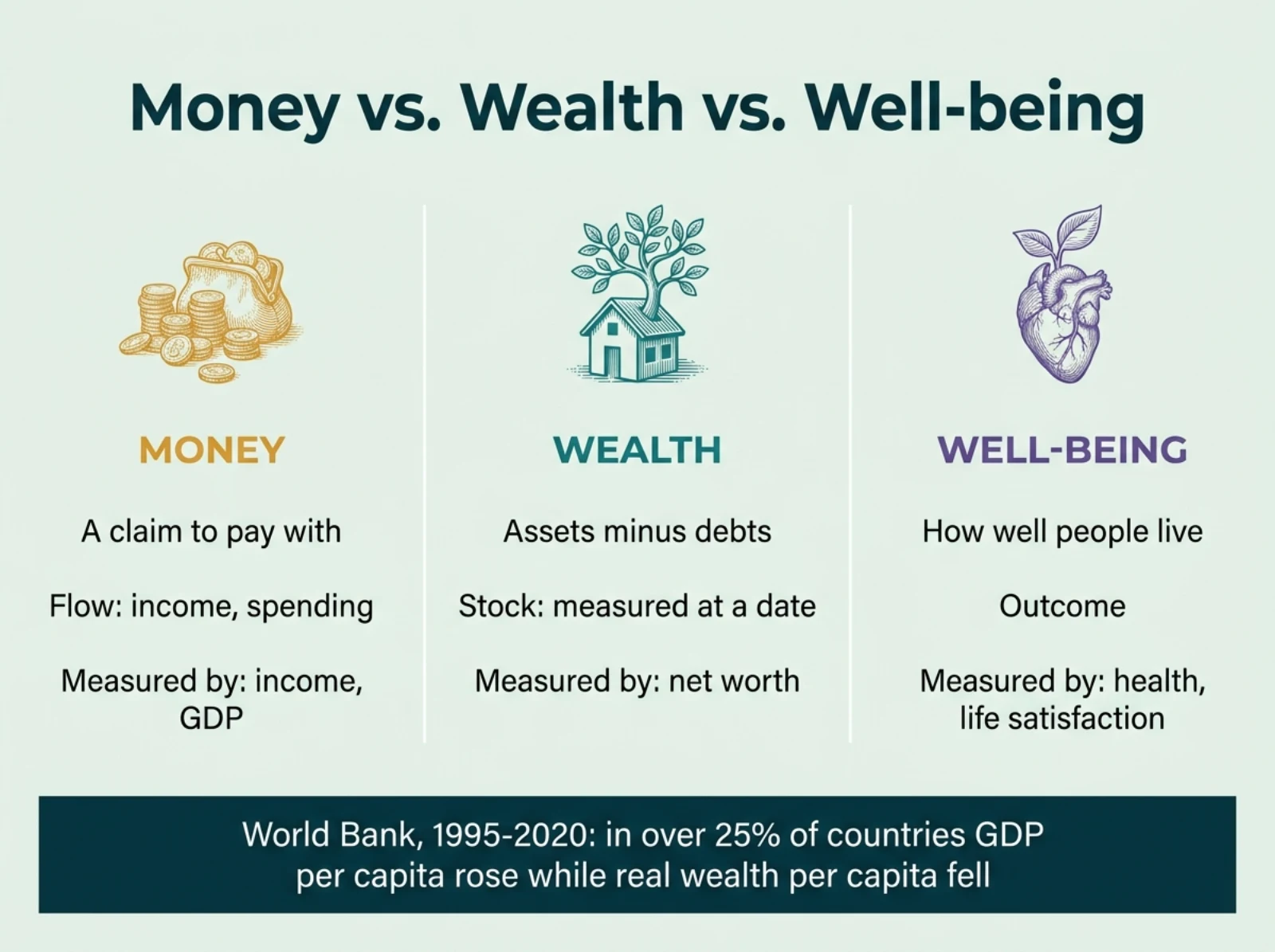
In everyday talk, a person who has a lot of money is called rich or wealthy, as if money and wealth were one thing. Economists keep them apart:
- Money is a medium of exchange and a unit of account. A dollar bill or a bank balance is a claim that lets you trade for goods, services and other people’s work.
- Wealth is the stock of things that have value: houses, land, machines, savings, businesses, skills. For a household, wealth usually means net worth, which is assets minus debts on a given date.
- Real wealth is the wider idea that an economy rests on productive capacity: fertile soil, forests, fish stocks, healthy and educated people, and trust. Economists sort these into natural, human, produced and social capital.
A fourth term, well-being, describes how good life is. It depends on wealth but also on health, free time and relationships.
Money vs. wealth vs. well-being, side by side
| Money | Wealth | Well-being | |
|---|---|---|---|
| What it is | A claim used to pay and settle debts | The stock of assets, minus debts | How well people live |
| Flow or stock? | Mostly a flow (income, spending) | A stock, measured at a date | An outcome |
| Typical measure | Income, GDP, bank balances | Net worth, national balance sheets | Life expectancy, life satisfaction, time use |
| How fast can it grow? | Fast: banks and central banks create it | Slowly, through saving and investment | Slowly |
| How is it lost? | Inflation, default | Depreciation, depletion, debt, disasters | Illness, insecurity |
| Who tracks it? | Central banks, statistics offices | Federal Reserve, World Bank | OECD, UN, statistics offices |
Behind the table sits an accounting fact. Every dollar is an asset for whoever holds it and a liability for the bank or central bank that issued it. Add up all those claims across a country and they largely cancel out. Most of what remains as national wealth is physical: buildings, equipment, land and natural resources.
Why GDP counts money flows, not wealth
Gross domestic product adds up the market value of goods and services produced in a year. It is a flow, closer to a country’s income than to its net worth. Cut down a forest and sell the timber, and GDP rises that year. The smaller forest never shows up as a loss.
GDP’s own designers saw the limit. In his 1934 report to Congress, economist Simon Kuznets wrote that “the welfare of a nation can, therefore, scarcely be inferred from a measure of national income.” The U.S. Bureau of Economic Analysis still quotes the line.
In 2009 a commission set up by the French government and led by Joseph Stiglitz, Amartya Sen and Jean-Paul Fitoussi published its report on measuring economic performance. It recommended looking at income and consumption rather than production alone, taking the household perspective, and considering income and consumption jointly with wealth. The authors also argued that you can only judge sustainability by tracking stocks of natural, physical, human and social capital.
When money grows and real wealth shrinks
The World Bank puts numbers on this in its series The Changing Wealth of Nations. The 2024 edition, still the latest as of October 2026, covers 1995 to 2020:
- Real wealth per capita grew by 21 percent worldwide over those 25 years.
- Human capital, the value of the workforce’s future earnings, made up about 60 percent of total wealth in 2020.
- Renewable natural capital per capita fell sharply: agricultural land by 24 percent, timber by 28 percent and marine fish stocks by more than 25 percent.
- In over 25 percent of countries, GDP per capita rose while real wealth per capita fell.
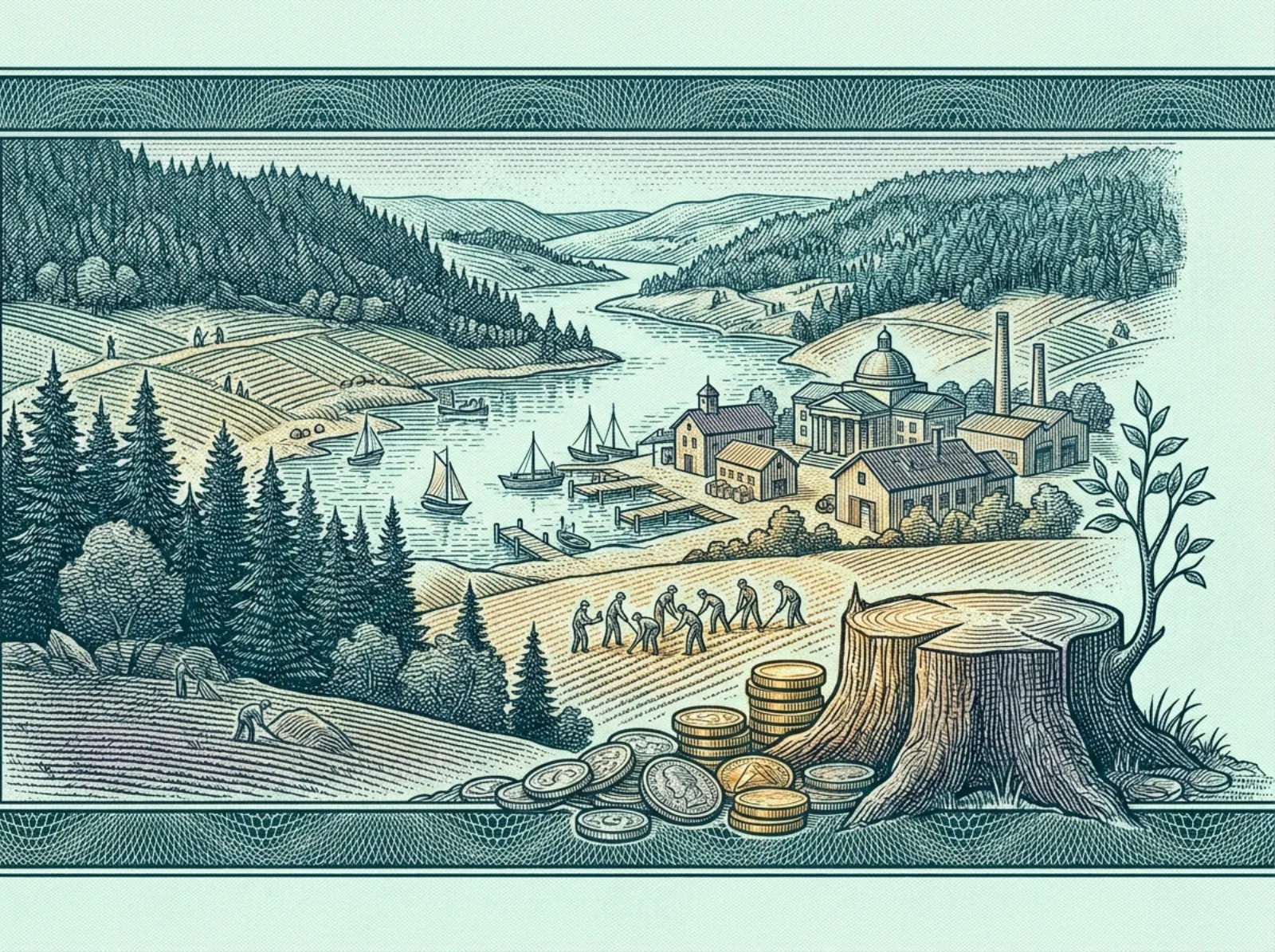
Critics of the current economic model read these numbers as a warning. Author David Korten, in his 2009 book Agenda for a New Economy, separates “phantom wealth” (gains from speculation, asset bubbles and debt) from real wealth that meets people’s needs. He argues that an economy can make more money while the living systems behind it decline. Bernard Lietaer took a related line and asked whether the way money itself is designed pushes economies toward short-term growth.
Many mainstream economists agree that GDP is no measure of wealth or welfare, but they reject the idea that finance is mostly phantom. Rising stock and house prices, they say, often reflect expected future income from actual businesses and homes, and credit lets families and firms invest before they have saved. Their preferred remedy is better accounting: price the depletion of natural resources and report wealth next to GDP.
How statisticians are counting wealth now
Official efforts to close the gap include:
- In 2012 the UN Statistical Commission adopted the SEEA Central Framework as the first international statistical standard for environmental-economic accounting.
- In March 2021 it adopted SEEA Ecosystem Accounting, which records the extent and condition of ecosystems and the services they provide.
- The World Bank’s wealth accounts estimate produced, natural, human and foreign wealth for over 150 countries.
- On May 7, 2026, a UN expert group released “Counting What Counts,” a dashboard of indicators meant to complement GDP. Member states are now discussing it.
The idea of natural capitalism carries this into business: it asks companies to treat ecosystems as assets on the books, not as free inputs.
What it means for your household
The same split applies at home. Income is the money that comes in from your job each month. Wealth is the rest: what you own minus what you owe. A family with a high income and heavy debt can be less wealthy than one with a modest job and a paid-off house.
The Federal Reserve’s 2025 Survey of Consumer Finances, released on October 9, 2026, shows how far apart the two measures sit in the United States. Median family income was $82,200, and median net worth was $215,900. Mean net worth was $1.24 million, pulled up by a small number of very rich households.
If you want to know how much money you have once debts are counted, a yearly check takes about an hour:
- List your assets: cash, retirement accounts, the market value of your home or car.
- List your debts: mortgage, student loans, car loans, credit card balances.
- Subtract debts from assets to get your net worth.
- Repeat each year and focus on the trend, not a single number.
Some people add a time measure, one way to think about financial freedom: how many months they could cover living costs without work. Others count skills, health and friends who would help in a crisis. Our guide to community currencies shows one local way to keep spending inside a town. This article is general information, not financial or investment advice.
Frequently asked questions
Is money the same as wealth?
No. Money is a claim you can spend. Wealth is what you own minus what you owe, including a home, a business or land.
What is the difference between being rich and being wealthy?
In popular finance writing, rich often means a high income or visible spending, while wealthy means saved assets that buy freedom and time. Morgan Housel makes this point in The Psychology of Money: wealth is mostly the income you did not spend, which is why you rarely see it.
Does GDP measure wealth?
No. GDP measures a year’s production and does not subtract lost forests, soils or fish stocks, which is why the World Bank and the UN keep separate wealth accounts.
What is real wealth?
The resources that let an economy provide for people over time: land and water, skills and health, buildings and machines, and social trust.
Sources
- World Bank: The Changing Wealth of Nations 2024
- Federal Reserve: Results of the 2025 Survey of Consumer Finances (October 9, 2026)
- U.S. Bureau of Economic Analysis: GDP and Beyond (Survey of Current Business, June 2020)
- United Nations: SEEA Ecosystem Accounting
- Report by the Commission on the Measurement of Economic Performance and Social Progress (Stiglitz, Sen, Fitoussi, 2009)