
Every company settles three questions in its founding papers: who owns it, who controls it and who receives the profits. In a traditional business owned by shareholders, investors hold all three. The cooperative business model and its newer relatives split them differently, and that changes how the business behaves.
This guide compares six models, with real companies and what researchers and critics have found. All of them touch an older debate about money and real wealth.
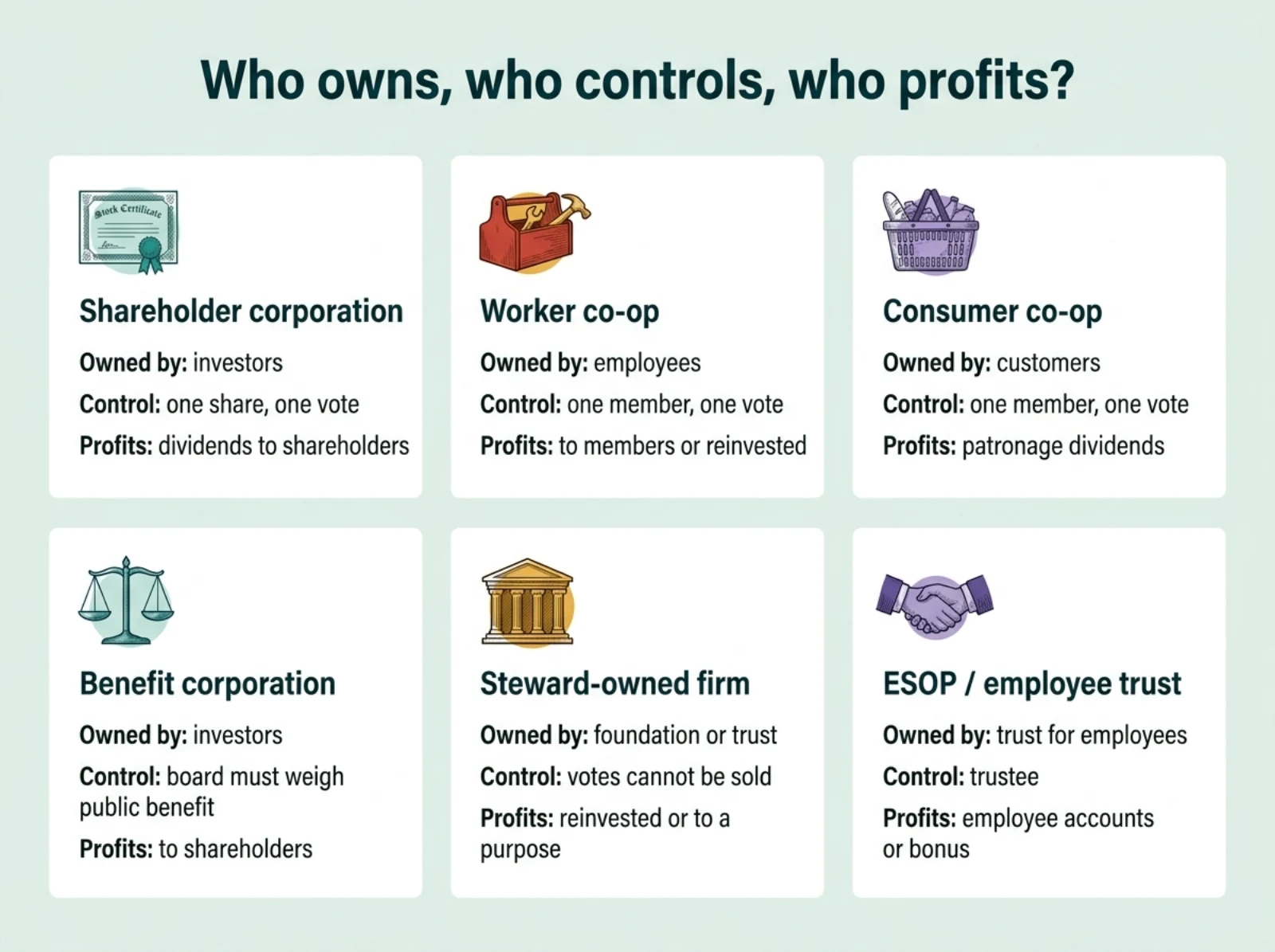
Six ownership models at a glance
| Model | Who owns it | Who controls it | Where profits go | Examples |
|---|---|---|---|---|
| Shareholder corporation | Investors | One share, one vote; shareholders elect the board | Dividends and buybacks | Most listed companies |
| Worker cooperative | Employees who are members | One member, one vote | Reinvested or paid to members by hours or pay | Mondragon, Equal Exchange |
| Consumer cooperative | Customers who are members | One member, one vote | Patronage dividends based on purchases | REI, credit unions |
| Benefit corporation / B Corp | Investors | Investors; directors must weigh a public benefit | Investors | Some 9,500 certified firms |
| Steward-owned firm | A foundation or purpose trust | Stewards whose votes cannot be sold | Reinvested or given to a purpose | Bosch, Carlsberg, Patagonia |
| ESOP / employee trust | A trust holding shares for staff | A trustee | Employees’ retirement accounts or bonuses | John Lewis Partnership |
How does the cooperative business model work?
A cooperative is owned and democratically controlled by the people who use the products and services it provides. Co-ops are owned by their customers, workers or producers, and they exist to meet the needs of their members, not to pay outside investors. Membership comes from using the co-op business. Under the one member, one vote principle, each member has the same say in decisions, however much capital they put in, and the board of directors is elected by the members.
The International Cooperative Alliance (ICA) sets out seven principles for the co-op model:
- Voluntary and open membership
- Democratic member control
- Member economic participation
- Autonomy and independence
- Education, training and information
- Cooperation among cooperatives
- Concern for community
When a co-op ends the year with a surplus, it can keep the money as reserves or return it to its members as patronage dividends, based on how much each member used the business.
According to the International Cooperative Alliance’s facts and figures, some 3 million cooperatives have more than 1 billion members, over 12 percent of humanity. They employ roughly 10 percent of the world’s employed population, and the 300 largest cooperatives and mutuals turn over $2.79 trillion (World Cooperative Monitor 2025, checked October 2026). Because their owners live where they trade, co-ops often appear in plans for building a local economy that serves the community.
Worker co-ops: Mondragon and Equal Exchange
Mondragon in Spain’s Basque Country began with a factory co-op in 1956. In 2024 the federation counted 81 self-governing cooperatives and 12 research centers. For 2025 it reported €11.3 billion in sales and 71,415 jobs.
Equal Exchange, a Massachusetts fair trade coffee and chocolate firm founded in 1986, is run as a worker-owned co-op. A 2026 Rutgers case study lists 125 employees and roughly $73 million in revenue.
Consumer co-ops: REI and credit unions
REI, the outdoor retailer founded in Seattle in 1938, is a consumer co-op. Members pay a one-time fee for lifetime membership and get an annual reward based on their purchases. Members also elect the board. REI reported more than 25 million members and $3.53 billion in net sales for 2024, along with a net loss. Credit unions apply this logic to financial services.
Benefit corporations: stakeholder capitalism inside the corporation
Stakeholder capitalism holds that a company serves workers, customers and communities as well as shareholders. In 2019, 181 chief executives in the Business Roundtable signed a statement endorsing that view. Benefit corporations put it into law: Maryland passed the first statute in 2010, and more than 30 states have followed. The company stays investor-owned, but its directors must consider a stated public benefit alongside profit.
A Certified B Corp is a private certification from the nonprofit B Lab, open to many legal forms. B Lab counted some 9,500 of them in 102 countries in March 2025. Supporters say both tools protect a mission when ownership changes. Critics reply that outsiders can rarely enforce the benefit duty and that owners can later convert the company back. Related ideas such as natural capitalism ask how markets could price nature properly.
Steward ownership: a foundation holds the shares
Steward-owned companies separate voting rights from financial rights. Control stays with people tied to the business, the votes cannot be sold, and profits are reinvested or given to a purpose.
- Bosch: the charitable Robert Bosch Stiftung holds roughly 94 percent of the share capital of Robert Bosch GmbH, while some 93 percent of the voting rights lie with Robert Bosch Industrietreuhand KG.
- Carlsberg: the Carlsberg Foundation’s charter requires it to hold at least 51 percent of the votes in Carlsberg A/S, which it does through A-shares with extra voting weight.
- Patagonia: in September 2022 the founding family moved all ownership to two entities. The Patagonia Purpose Trust holds the voting stock, 2 percent of the total. The Holdfast Collective holds the other 98 percent and receives profits not reinvested, projected at around $100 million a year.
Employee ownership: ESOPs and trusts
An employee stock ownership plan (ESOP) is a US retirement trust that owns company shares for the workforce. The National Center for Employee Ownership counts 6,609 ESOPs with 15.1 million participants and over $2 trillion in assets, based on 2023 federal data. An ESOP is not a worker co-op: a trustee holds the shares, and employees rarely get an equal say in decisions.
The UK’s John Lewis Partnership is the trust version. John Spedan Lewis signed trust deeds in 1929 and 1950, and the business now belongs to a trust for its staff, called Partners, of whom there were around 69,000 in the year to January 2025. An elected Partnership Council can remove the chairman, and Partners share a bonus set at the same percentage of pay for everyone.
What does the research say?
Several studies point in the same direction:
- Survival: a 2014 study of Uruguayan firms by economist Gabriel Burdín in the ILR Review found the risk of dissolution was 29 percent lower for worker-managed firms than for conventional ones, after excluding microenterprises.
- Productivity: a 2016 review by Virginie Pérotin for Co-operatives UK concluded that worker co-ops are at least as productive as conventional firms, and in several industries organize production more efficiently.
- Jobs: the same review found that worker co-ops tend to cut pay rather than jobs in a downturn and reinvest more profit than their rules require.
What do critics say about co-ops and their rivals?
Economists who study ownership raise three recurring concerns:
- Capital: co-ops cannot offer outside investors control or a share of growth, and members usually cannot sell their stake at market value. Legal scholar Henry Hansmann has argued that the costs of collective decision making explain why worker ownership remains rare.
- Scale: large co-ops can drift toward conventional practice. Many people at Mondragon’s foreign subsidiaries are not members, and its appliance maker Fagor Electrodomésticos went insolvent in 2013.
- Governance and participation: equal voting can mean slow decisions, low turnout and free riders. Benefit corporations and steward-owned firms face another question, namely how managers are held to account when no outside investor can sell or sue.
Supporters answer that members are patient owners who keep jobs in the community, and that the survival data show the co-op model can compete.
Which model fits which goal?
Each structure trades capital, control and mission against one another. If you are weighing options for your own business, common matches look like this:
- Raise outside equity fast: shareholder corporation, with or without benefit status.
- Give customers or producers control of a shared service: consumer or producer co-op.
- Put workers in charge of their workplace: worker cooperative.
- Sell a family firm to staff over time: ESOP or employee ownership trust.
- Keep independence across generations: steward ownership.
Laws and tax rules differ by country and state, so founders usually take legal advice first.
Sources
- International Cooperative Alliance: Facts and figures
- National Center for Employee Ownership: ESOPs by the Numbers
- Patagonia: Earth is now our only shareholder (press release, September 14, 2022)
- Bosch: The Bosch Group at a glance (shareholder structure)
- Burdín (2014): Are Worker-Managed Firms More Likely to Fail Than Conventional Enterprises? ILR Review 67(1)