In a Bavarian lake district, shoppers pay with paper notes that expire after six months unless someone buys a stamp for them. In western Massachusetts, more than 300 local businesses take a currency printed for their region. Both are a local currency: money a community issues for itself and uses alongside the national one.
Some schemes have run for decades, but many have closed. Below are the models, ten real cases with their status as of October 2026, and the steps for starting one.
What is a local currency?
A local currency, also called a community currency or complementary currency, is a means of payment for goods and services that circulates within a town, region or network. Unlike fiat money issued by a central bank, community currencies are created by citizens, businesses or nonprofits. They sit next to the national currency, and only participants accept them.
Finance texts use “local currency” for a country’s official money, such as the euro in Germany. This guide covers the kind the community creates. It ties into the older debate about the difference between money and real wealth.
How are community currencies backed?
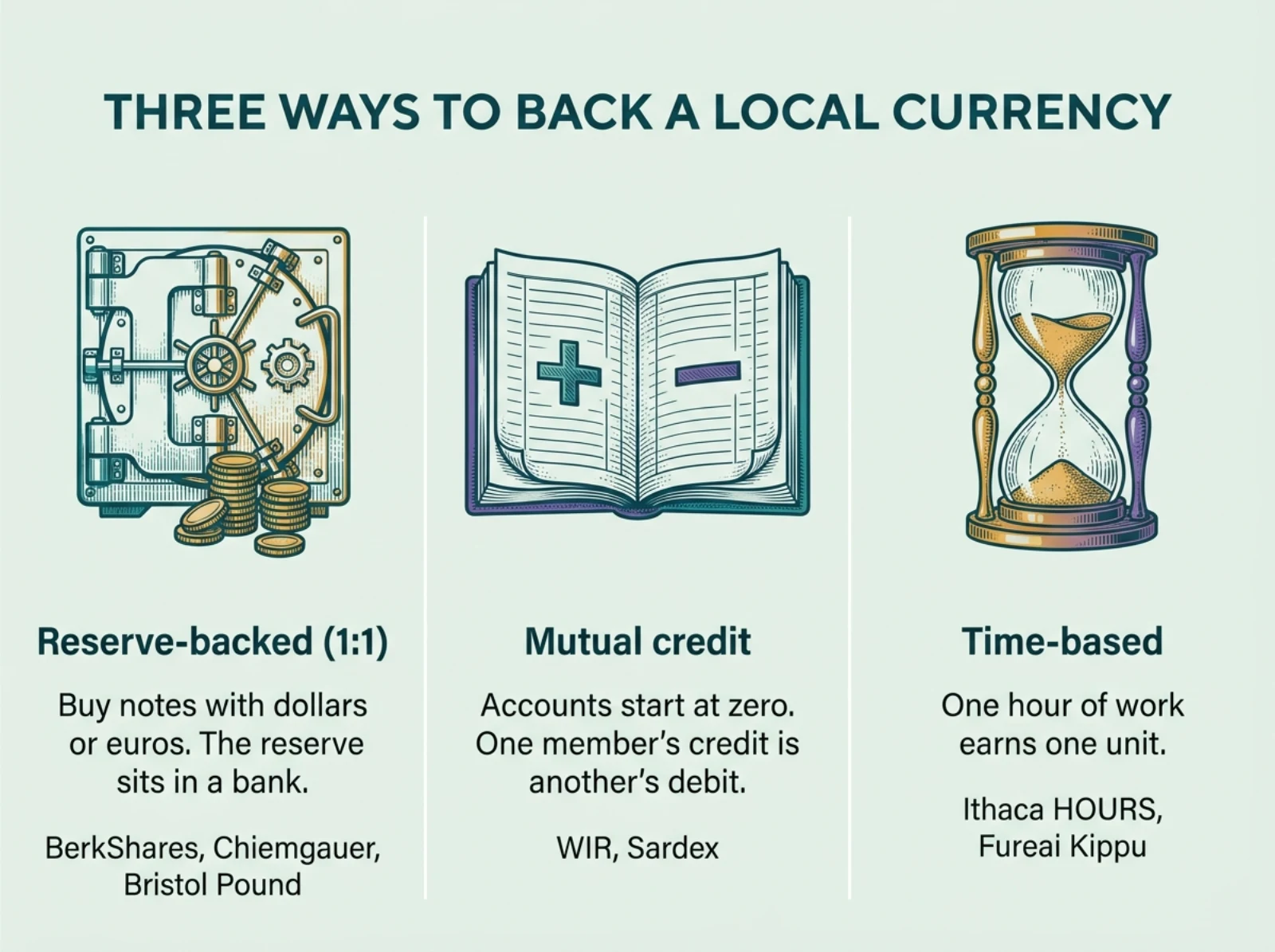
There are three main models, and the choice decides who carries the risk and how much currency can exist.
| Model | How the currency is created | Examples | Typical weak point |
|---|---|---|---|
| Reserve-backed (1:1) | Members buy notes with dollars or euros; the reserve sits in a bank | BerkShares, Chiemgauer, Bristol Pound | Adds no new purchasing power; needs exchange points |
| Mutual credit | Accounts start at zero; each member’s credit is another member’s debit | WIR, Sardex, LETS | Members who never settle a negative balance |
| Time-based | An hour of work earns a unit, whatever the job | Ithaca HOURS, Fureai Kippu, time banks | Skilled trades may stay away |
Some schemes add demurrage, a small fee on notes that sit unused, so they keep moving. The Belgian economist Bernard Lietaer argued that complementary currencies can steady local economies when fiat money runs short.
10 local currency examples and what each one teaches
1. Wörgl, Austria (1932 to 1933)
During the Depression, the Tyrolean town of Wörgl issued “labor certificates” on July 31, 1932. They lost 1% of their value each month unless the holder bought a stamp, and a schilling deposit at a local bank backed them. The experiment ended in September 1933 after the Austrian National Bank contested the town’s right to issue currency. The lesson: national monetary law sets the limits.
2. WIR, Switzerland (since 1934)
Swiss business owners founded the WIR cooperative in 1934 so small firms could trade on credit when francs were scarce. Bank WIR, today also a regular bank, reported CHF 6.1 million in 2025 fee income from clearing the WIR currency (code CHW). A year earlier it said demand for WIR had fallen again because interest rates were low. Economist James Stodder found that WIR use tends to rise in economic downturns.
3. Ithaca HOURS, New York (from 1991)
Paul Glover launched Ithaca HOURS in November 1991. Each HOUR equaled $10, roughly an hour of local wages then. Use faded when payments went electronic, and revival attempts around 2019 did not succeed. The lesson: plan for succession and for electronic payments.
4. Fureai Kippu, Japan (from 1973)
This time currency began in Osaka in 1973 as the Volunteer Labour Bank and grew nationally in the 1990s. Volunteers earn credits for social care services to older neighbors. They can save them to pay for their own care later or transfer them to a parent living elsewhere. About 400 branches and some 70,000 people took part, per a University of Sheffield research profile. After Japan’s 2000 Long-Term Care Insurance Act, many paid volunteers moved into the new insured care market.
5. Chiemgauer, Bavaria (since 2003)
A teacher and his students in Prien am Chiemsee started the Chiemgauer in 2003. It trades 1:1 with the euro. Changing it back costs 5%: 2% funds the system and 3% goes to a local club the member picked. In October 2026 the association’s website listed 936,711 Chiemgauer in circulation, 4,265 consumers, 347 businesses and €969,515 raised for local groups.
6. BerkShares, Massachusetts (since 2006)
BerkShares circulate in the Berkshire region, backed by federal dollars on deposit at local banks. In March 2025 the organization counted more than 300 participating businesses, about B$140,000 in circulation (a 2023 figure) and a 1.5% fee to change notes back. But it says it needs a digital payment platform to grow.
7. Brixton Pound, London (since 2009)
Transition Town Brixton launched the B£ in 2009 with support from Lambeth council, which later let staff take part of their salary in it. As of October 2026 the website says the Brixton Pound is “undergoing a governance transition” and is inactive while that work takes place.
8. Bristol Pound, England (2012 to 2021)
At its peak, the Bristol Pound moved about a million units a year through hundreds of businesses, and the city accepted it for local taxes. In 2020 it needed £100,000 to cover £13,000 in monthly running costs. The notes were withdrawn in September 2021. Its director later said only about 0.02% of residents used it and that it burdened small firms with paperwork.
9. Sardex, Sardinia (since 2010)
Sardex is a business-to-business mutual credit network. Member firms get interest-free credit lines in Sardex credits, valued 1:1 with the euro, and buy goods and services from each other without spending euros. A 2018 study in *Nature Human Behaviour* analyzed 1,477 businesses and 48,170 transactions in the network. It now operates as SardexPay.
10. Sarafu, Kenya
On Grassroots Economics’ Sarafu Network, people issue vouchers that promise future goods or labor and trade them in shared pools, even from basic phones. As of July 2025 it reported 4,476 users and 251,449 exchanges since mid-2023. In its own survey of 855 users, 71% were women.

Why do many local currencies end?
Most complementary currencies end for practical reasons:
- Running costs outgrow fees and grants, as in Bristol.
- Card and phone payments push paper scrip aside.
- Volunteers burn out. The Lewes Pound in England, for example, ended on August 31, 2025, after its organizers found no one to take it over.
- Businesses that cannot spend what they take in convert it back, so circulation shrinks.
Supporters argue that these currencies keep spending in the area and strengthen social and economic ties, which gives towns a cushion in a crisis. Critics reply that a reserve-backed note does not add purchasing power, mostly shifts spending between shops, and costs more to run than it returns. Long-term research is thin, so both sides lean on case studies.
Are local currencies legal in the US?
Yes, within limits (general information, not legal advice).
- They are not legal tender. Only US coins and currency are, and nobody has to accept a local note.
- Federal law bars private coins meant to serve as money, and counterfeiting law covers anything that resembles dollars. Paper notes with their own design, like BerkShares, have circulated openly for years.
- Income in local currency is taxable. The IRS says you must report the fair market value of goods or services received by bartering in the year you receive them (IRS Topic 420, Bartering income). Organized barter exchanges file Form 1099-B; an informal swap of similar services, such as a babysitting co-op, is not a barter exchange.
- Digital versions may raise state money transmitter questions.
How do you start a local currency?
- Name the purpose and the area. Keeping shop spending local, paying for care work and helping firms short of cash need different designs. The basics of building a local economy help here.
- Pick a backing model (see the table).
- Recruit businesses before printing. You need a loop: shops that can pay suppliers, staff or local taxes in the currency.
- Find a bank or credit union to hold the reserve and act as an exchange point.
- Get legal and tax advice, and design notes that look nothing like dollars.
- Budget the operation. Set fees (Chiemgauer charges 5%, BerkShares 1.5%) and plan digital payments from day one.
- Plan for succession: a board, shared volunteer work and circulation figures published every year.