
Plenty of veterans never receive what they earned. Some assume they don’t qualify because they were never wounded; others get lost in the forms. Here are veterans benefits explained step by step: what the U.S. Department of Veterans Affairs (VA) offers, who is eligible for which program, how to apply, where the system gets stuck and how Congress pays for it.
This is general information, not legal or medical advice.
What VA benefits cover: the veterans benefits list
The Veterans Health Administration runs health care. The Veterans Benefits Administration handles cash payments, education and training, home loans and life insurance, and the National Cemetery Administration runs burials.
| Benefit | What it provides | Basic condition |
|---|---|---|
| Health care | Medical, mental health and some dental care at VA sites or through community providers | Qualifying service, discharge not dishonorable |
| Disability compensation | Tax-free monthly payment | Illness or injury caused or worsened by service |
| Veterans Pension | Monthly payment for low-income wartime veterans | Wartime service, age 65+ or permanent disability, income and net worth limits |
| GI Bill | Tuition, housing allowance, books stipend | Enough active duty, for example 90 days after September 10, 2001 |
| Home loans | VA-backed mortgages, often with no down payment | Certificate of Eligibility based on service |
| Life insurance | Coverage such as Veterans’ Group Life Insurance (VGLI) | Depends on program and timing |
| Veteran Readiness and Employment | Job training, counseling, employment assistance | Service-connected condition |
| Burial | Gravesite in a national cemetery, headstone, burial flag, burial allowance | Discharge not dishonorable |
TRICARE, often mixed up with VA care, is a separate Defense Department insurance program for service members, military retirees and their families.
Who is eligible for VA health care
For VA health care eligibility, the starting point is service in the active military, naval or air service without a dishonorable discharge. Most who joined after 1980 also need 24 continuous months or the full period they were called up for, with some exceptions. Guard and Reserve members may qualify for health care benefits if they were called to active duty by federal order.
You do not need a rating to enroll. A rating does move you into a higher priority group, though. The VA sorts enrollees into eight priority groups, and your priority group affects how quickly you are enrolled and what copays you owe. Veterans without a service-connected condition may still qualify for care based on income.
As of October 2026 the VA reports more than 9.1 million veterans enrolled, served at 170 medical centers and 1,193 outpatient sites.
The PACT Act and toxic exposure
The Honoring our PACT Act of 2022 added presumptive conditions for veterans exposed to burn pits, Agent Orange and radiation: the VA assumes service caused certain illnesses instead of asking the veteran to prove it. The burn pit list includes several cancers, asthma diagnosed after service, COPD and other lung diseases.
Since March 5, 2024, veterans who served in the Vietnam War, the Gulf War, Iraq, Afghanistan or another post-9/11 combat zone, deployed in support of the Global War on Terror, or were exposed to toxins in the military are eligible for direct enrollment, without first filing for compensation. Every enrolled veteran also gets a toxic exposure screening, repeated at least every five years. Gulf War veterans curious about one disputed exposure can read our explainer on depleted uranium and health.
How VA disability ratings and pay work
VA disability compensation pays veterans whose condition began or got worse during service, or one the law presumes is connected. The VA assigns a rating from 0 to 100 percent in steps of 10. Several conditions are combined with a formula, so two 50 percent ratings do not add up to 100.
Monthly rates for a veteran with no dependents, effective December 1, 2025 (current as of October 2026):
| Combined rating | Monthly payment |
|---|---|
| 10% | $180.42 |
| 30% | $552.47 |
| 50% | $1,132.90 |
| 70% | $1,808.45 |
| 100% | $3,938.58 |
From 30 percent up, dependents raise the payment. Full figures are in VA’s current compensation rate tables, which change each December with the cost-of-living adjustment.
VA disability pay and VA pension are often confused. Compensation depends on a service-connected condition, and income plays no role. Pension is need-based: wartime veterans with limited income and net worth may qualify for it if they are 65 or older, permanently and totally disabled, in a nursing home, or receive Social Security disability payments.
How to apply for VA benefits
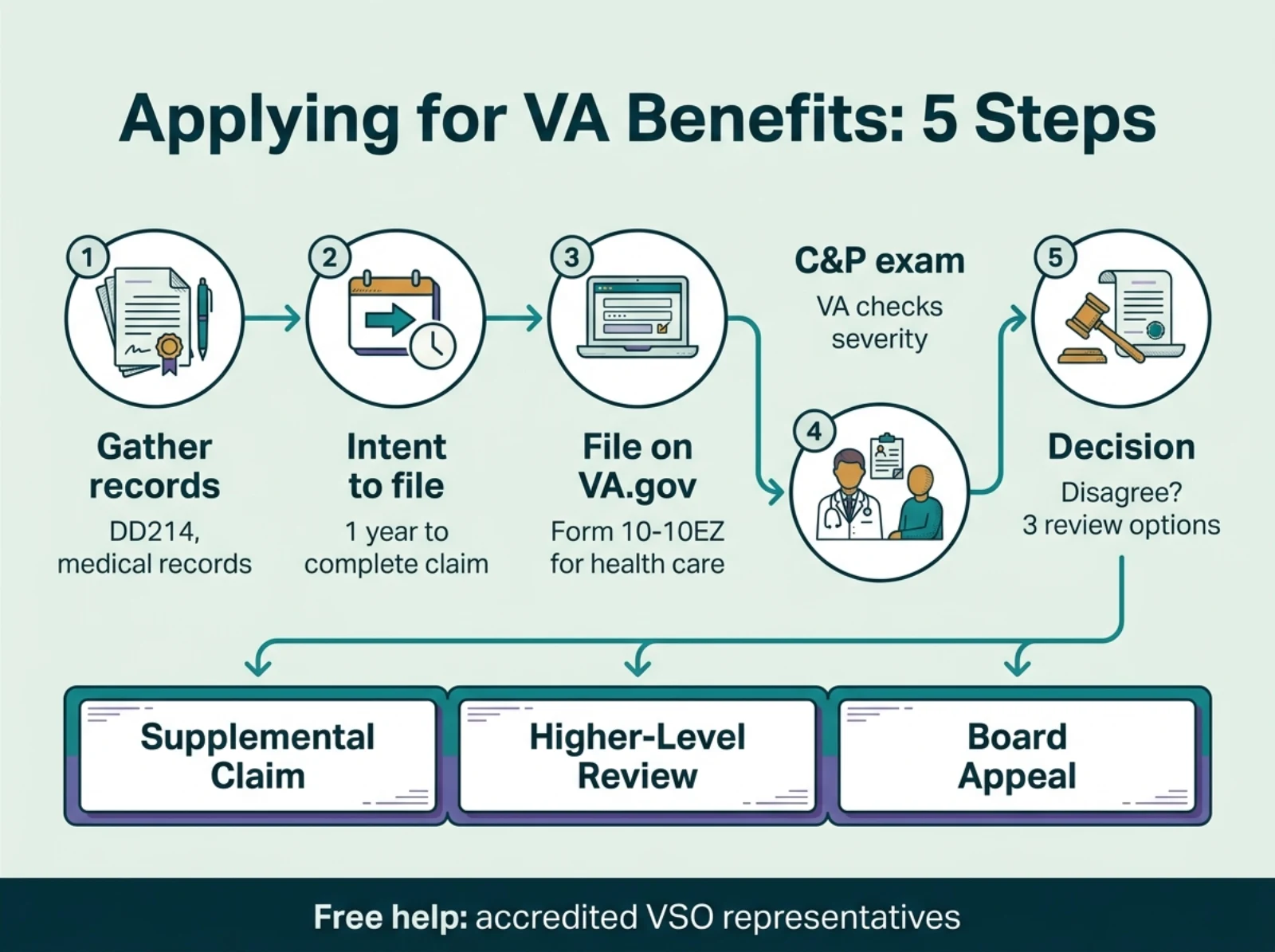
- Gather records. Discharge papers (DD214), medical records and evidence that links a condition to service.
- Submit an intent to file. It sets a potential start date for payments. You then have one year to complete the application, and an approved claim can pay back to that date.
- File. Most applications go through VA.gov; health care enrollment uses VA Form 10-10EZ.
- Attend the exam. The VA often schedules a compensation and pension (C&P) exam to judge severity.
- Review the decision. If you disagree, you have three routes: a Supplemental Claim with new and relevant evidence, a Higher-Level Review by a senior reviewer, or an appeal to the Board of Veterans’ Appeals.
The VA accredits three kinds of helpers: representatives of veterans service organizations (VSOs) such as the DAV, The American Legion or the VFW, attorneys, and claims agents. According to the VA, assistance from an accredited VSO representative is always free. Attorneys and agents may generally charge only after the VA decides an initial claim. State and county veterans offices also offer help.
Common problems: backlogs, old rules and delays
The VA counts a claim as backlogged after 125 days pending. In September 2026 the agency said it had processed a record of more than 3 million disability claims in fiscal year 2026 and cut the backlog by about 70 percent.
The Government Accountability Office (GAO) has kept VA’s compensation program on its High-Risk List since 2003. In a January 2026 report, GAO found that VA had updated medical criteria for 11 of 15 body systems but still based earnings-loss calculations on data from 1945, and warned that VA “may overcompensate some veterans while undercompensating others.”
The VA calls the PACT Act perhaps the largest health care and benefit expansion in its history. The Toxic Exposures Fund it created accounts for $54.6 billion in the FY2027 request, according to the Congressional Research Service (CRS).
How VA funding is set
- Mandatory spending covers benefits set in law: compensation, DIC, pension, the GI Bill, Veteran Readiness and Employment, life insurance, burial benefits and care paid from the Toxic Exposures Fund. Congress appropriates what cost projections say eligible veterans will draw.
- Discretionary spending covers most VA medical care, research, construction, IT, the Board of Veterans’ Appeals and cemeteries. Congress sets these amounts every year.
Most medical care is funded a year ahead through advance appropriations, so a late budget does not halt it.
Figures as of October 2026, from CRS:
- FY2026 enacted: about $445.5 billion ($312.3 billion mandatory, $133.2 billion discretionary).
- FY2027 request: $481.9 billion ($337.2 billion mandatory, $144.7 billion discretionary), an increase of 8.2 percent. VA’s own budget documents count some accounts differently, so headline totals vary.
- Status: No full-year FY2027 bill has been enacted. A continuing resolution signed September 2, 2026, funds VA through December 11, 2026, largely at FY2026 rates. The House passed its version (H.R. 8469) on May 15, 2026.
The budget also proposes to regroup the four medical accounts into “direct care” and “community care” from the FY2028 cycle. The House-passed bill did not include that change. Readers who want to learn more about following these votes can start with our guide to civic participation.
Practical tips for veterans and their families

- Ask a free accredited VSO representative before paying anyone. Be cautious with unaccredited “claim consultants.”
- Apply for health care benefits even without a rating. PACT Act rules may make you eligible for enrollment.
- If a condition gets worse, you can ask for a higher rating.
- Check GI Bill deadlines. If your service ended before January 1, 2013, Post-9/11 benefits expire after 15 years.
Frequently asked questions
Do I need a disability rating to get VA health care?
No. Qualifying service and discharge are the basic test. A rating or certain service history raises your priority group.
Can family members receive VA benefits?
Yes, in several programs. Dependency and Indemnity Compensation (DIC) offers monthly payments for eligible surviving spouses and children, CHAMPVA covers health care for certain family members, and spouses may be eligible for burial in a national cemetery.
Sources
- VA: Current Veterans disability compensation rates
- VA: Eligibility for VA health care
- VA: The PACT Act and your VA benefits
- GAO-26-108844: VA Disability Benefits: Progress Made but VA Decisions on Veterans' Claims Continue to Be Based, in Part, on Outdated Criteria
- Congressional Research Service R49347: Overview of the Department of Veterans Affairs FY2027 Appropriations