Between 1850 and 2019, human activity released roughly 2,390 billion tonnes of carbon dioxide into the atmosphere. Global warming tracks that running total closely.
The carbon budget turns this into an accounting tool. It also explains a claim that sounds radical: much of the coal, oil and gas already counted as reserves cannot be burned if the world wants to stay within the temperature target of the Paris Agreement.
What is a carbon budget?
A carbon budget is the total amount of carbon dioxide the world can still emit while keeping global warming below a chosen limit with a given probability. Carbon budgets are usually expressed in gigatonnes (billion tonnes) of CO2, written GtCO2.
The idea rests on a near-linear relationship the IPCC confirms with high confidence: every 1,000 GtCO2 of cumulative emissions raises global surface temperature by roughly 0.45 °C (likely range 0.27 to 0.63 °C). Warming stops rising only when net CO2 emissions reach zero.
Three choices shape every carbon budget figure you read:
- The temperature limit, most often 1.5 °C or 2 °C above pre-industrial levels (the 1850–1900 average).
- The probability of limiting warming to that level, for example 50 or 67 percent. Higher confidence means a smaller budget.
- The start date, since the remaining budget shrinks each year by roughly what the world emits.
The remaining carbon budget counts only CO2, but it already subtracts the expected warming from methane and other greenhouse gas emissions, which depends on how the climate responds to each gas.
How much of the carbon budget is left (as of October 2026)?
The reference point is the IPCC’s Sixth Assessment Report from 2021. Counting from the start of 2020, it estimated these remaining budgets in Table SPM.2 of the IPCC Working Group I Summary for Policymakers:
| Warming limit | 50% chance | 67% chance | 83% chance |
|---|---|---|---|
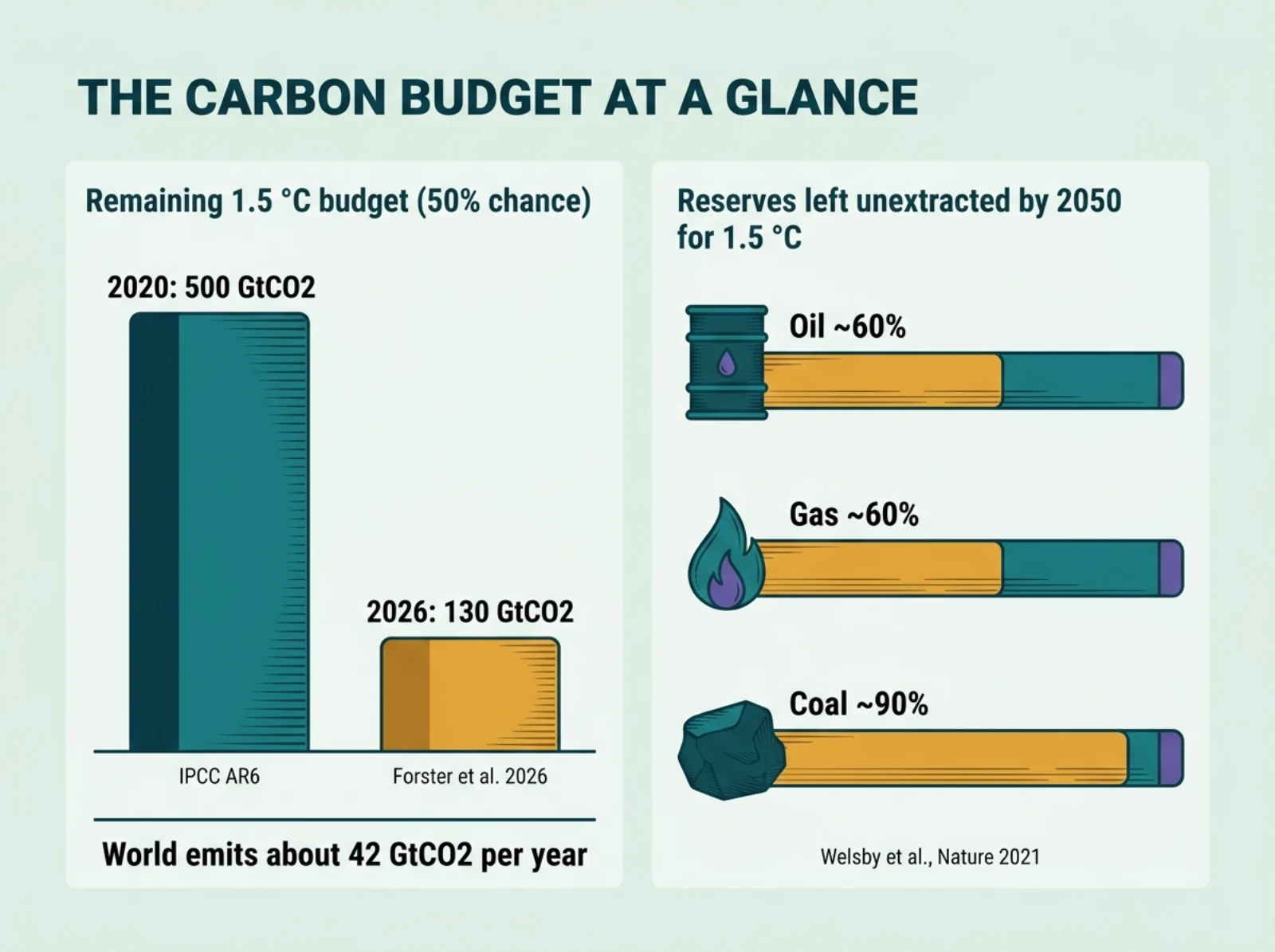
| 1.5 °C | 500 GtCO2 | 400 GtCO2 | 300 GtCO2 |
| 2 °C | 1,350 GtCO2 | 1,150 GtCO2 | 900 GtCO2 |
Six years of emissions from fossil fuels and land use have been spent since then. The latest annual updates come from two scientific teams:
- *Indicators of Global Climate Change 2025* (Forster et al., Earth System Science Data, 2026) puts the remaining budget for a 50 percent chance of 1.5 °C at about 130 GtCO2 from the start of 2026. At 2025 emission levels of roughly 42 GtCO2 a year, that lasts a little more than three years. The report puts human-induced warming in 2025 at 1.37 °C.
- The Global Carbon Project’s *Global Carbon Budget 2025* gives 170 GtCO2 for 1.5 °C, around four years of current emissions, 525 GtCO2 for 1.7 °C and 1,055 GtCO2 for 2 °C (roughly 25 years). It projected record fossil CO2 emissions of 38.1 billion tonnes for 2025.
The figures differ because of methods and data, yet both teams conclude that the remaining carbon budget for 1.5 °C is nearly used up. “Three years left” is not a date on which the world crosses 1.5 °C, because natural variability and non-CO2 gases shift the actual crossing point.
Why do studies say most reserves can’t be burned?
Reserves are fossil fuels that are known and economically recoverable today. Burning all of them would release far more CO2 than any budget above allows. That gap is what “unburnable carbon” refers to.
In 2015, Christophe McGlade and Paul Ekins of University College London estimated in *Nature* that global reserves held around three times the CO2 of the budget for a 50 percent chance of 2 °C. To stay within it between 2010 and 2050, their model left unused:
- roughly a third of oil reserves,
- half of gas reserves,
- over 80 percent of coal reserves.
They also found Arctic development and any expansion of unconventional oil incompatible with 2 °C. Headlines often rounded this to “keep 80 percent in the ground,” although that is the coal share.
A 2021 *Nature* study by Dan Welsby and colleagues redid the analysis for 1.5 °C. For a 50 percent chance, nearly 60 percent of oil and fossil methane gas and 90 percent of coal reserves would stay unextracted by 2050, and oil and gas output would fall around 3 percent a year. The authors call this probably an underestimate, partly because large-scale carbon removal is uncertain.
What does “keep it in the ground” mean for countries?
“Keep it in the ground” is shorthand for supply-side climate policy: limiting extraction, alongside demand-side tools such as efficiency standards or carbon pricing. Where it has been tried:
- Denmark voted in December 2020 to cancel future oil and gas licensing rounds and end production by 2050.
- The Beyond Oil and Gas Alliance, launched by Denmark and Costa Rica at COP26 in 2021, asks core members to stop new licensing. No major producing country has joined.
- In Ecuador, nearly 59 percent of voters chose in an August 2023 referendum to stop oil extraction in Block 43 in Yasuní National Park, a field producing around 11 percent of national crude. The state oil company called the court’s one-year closure deadline practically impossible.
- At COP28 in December 2023, countries agreed on “transitioning away from fossil fuels in energy systems, in a just, orderly and equitable manner,” the first such wording in a UN climate decision.
Fossil-fuel-dependent and lower-income countries, and many advocates of faster climate action, often frame the budget as a fairness question: who uses the remaining carbon space, and who pays for leaving resources unused? Our guide to civic participation shows how citizens can follow such decisions locally.
What does it mean for investors?
If fuels cannot be burned, the fields, mines and power plants built for them could lose value early. These are called stranded assets.
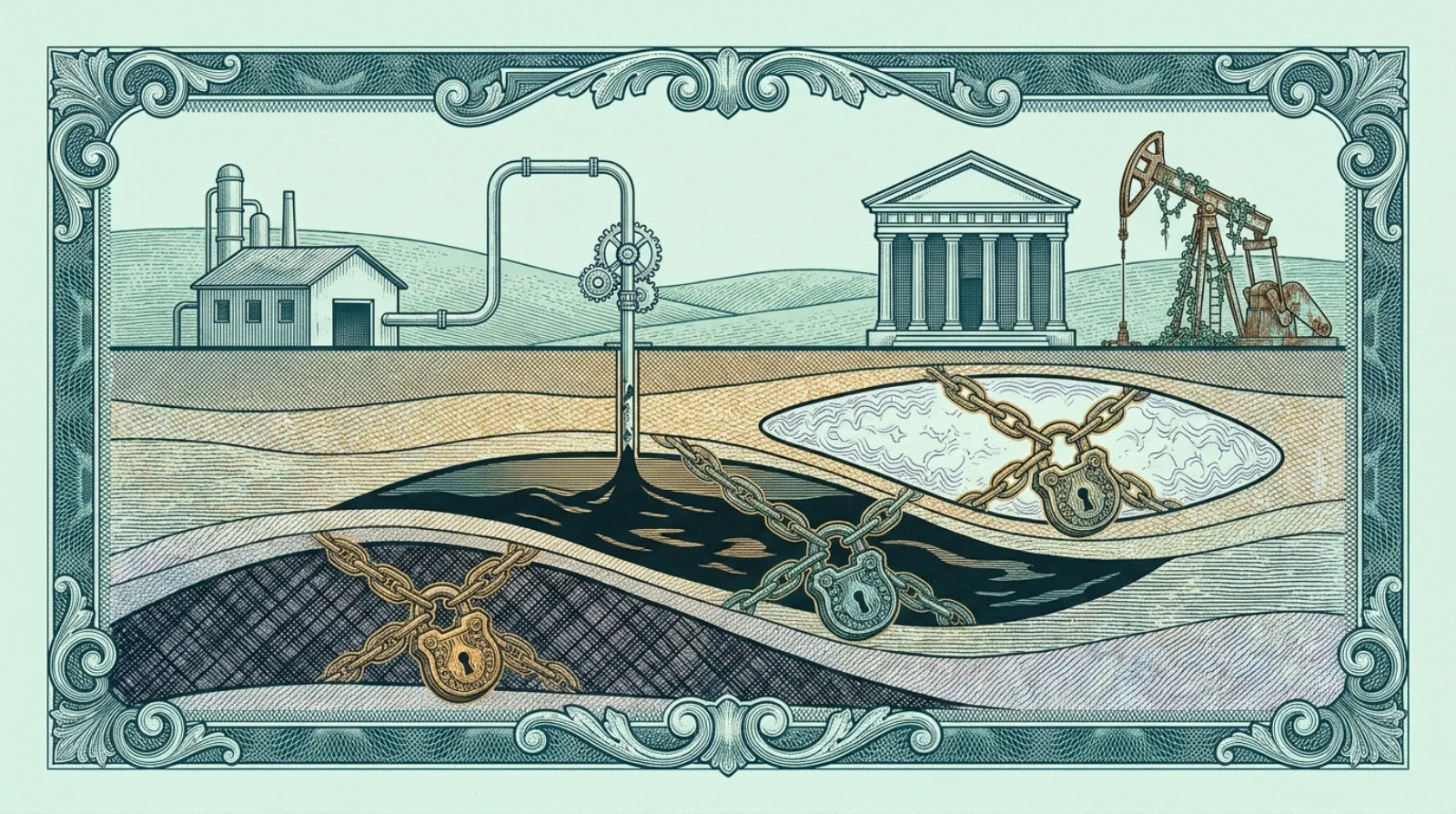
A 2022 study in *Nature Climate Change* by Semieniuk and colleagues estimated that a shift in climate policy expectations could strand more than US$1 trillion in future upstream oil and gas profits, mostly owned by private investors in OECD countries, including pension funds. The International Energy Agency’s 2021 *Net Zero by 2050* pathway approved no new oil and gas fields beyond those already committed that year.
How markets value natural resources is an older debate; see our explainers on natural capitalism and money versus real wealth.
What do critics and the industry say?
The carbon budget is broadly accepted in climate science. How to act on it is contested:
- Energy security: The IEA reported in September 2025 that nearly 90 percent of upstream investment since 2019 went into offsetting declines at existing fields; without new investment, oil output would fall roughly 8 percent a year. Producer countries and industry groups argue that cutting supply faster than demand would raise prices. Supporters of supply limits reply that the same analysis shows less new supply is needed if demand falls.
- Budget uncertainty: The IPCC lists uncertainties of several hundred GtCO2, with ±550 GtCO2 from historical warming alone.
- Carbon capture and removal: Industry groups argue that carbon capture and storage (CCS) and direct removal of CO2 from the air could allow more reserves to be used. Welsby’s team names their deployment as one of the largest uncertainties.
- Company outlooks: In 2014 ExxonMobil told shareholders that “none of our hydrocarbon reserves are now or will become ‘stranded,'” judging a low-carbon scenario unlikely. Carbon Tracker disputed that risk assessment.
Frequently asked questions
What happens when the carbon budget runs out?
Nothing switches off on that date. Once the 1.5 °C budget is spent, that limit can likely only be met by later removing CO2 from the atmosphere, an “overshoot” pathway. Each extra billion tonnes emitted adds to the warming that removal would have to reverse.
Is the global carbon budget the same as a national one?
No. The global budget is a scientific estimate. Some countries, such as the UK, set legal five-year carbon budgets that cap their own emissions.
Is the 1.5 °C goal still possible?
The Global Carbon Project’s lead author said in 2025 that keeping warming below 1.5 °C is no longer plausible while emissions keep rising. Other researchers focus on limiting how far and how long warming overshoots.
Sources
- IPCC AR6 Working Group I: Summary for Policymakers
- Forster et al. (2026): Indicators of Global Climate Change 2025, Earth System Science Data
- Global Carbon Project: The Global Carbon Budget FAQs 2025
- McGlade & Ekins (2015): The geographical distribution of fossil fuels unused when limiting global warming to 2 °C, Nature
- Welsby et al. (2021): Unextractable fossil fuels in a 1.5 °C world, Nature